
Polyclonal Rabbit anti-Human SLC5A11 / SMIT2 Antibody (WB)
Catalog Number: LS-C748223
2 sizes / from $281.00
Antibody: Rabbit Polyclonal
Applications: Immunohistochemistry (general), Western Blot
Reactivity: Human, Mouse, Rat
Format: Liquid

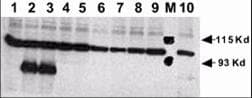
Rabbit anti-Human NOTCH 1 (Cleaved N Terminal) was used at a 1:500 dilution to detect mouse Notch 1 by Western blot. Equivalent amounts of lysates from transiently transfected 293 cells expressing recombinant myc-tagged mouse Notch constructs were electrophoresed and transferred to membrane using standard methods. A reaction with diluted primary antibody was followed by washing; reaction with a 1:10000 dilution of HRP conjugated Gt-a-Rabbit IgG, and color development. Lane M: Mol wt markers. Lane 1: No transfection. Lane 2: N1 (mouse deleted extracellular domain)-myc. Lane 3: N1 (mouse intracellular domain)-myc. Lane 4: N2 (mouse deleted extracellular domain)-myc. Lane 5: N2 (mouse intracellular domain)-myc. Lane 6: N3 (mouse deleted extracellular domain)-myc. Lane 7: N3 (mouse intracellular domain)-myc. Lane 8: N4 (mouse deleted extracellular domain)-myc. Lane 9: N4 (mouse intracellular domain)-myc. Lane 10: N1 (mouse deleted extracellular domain)(V to G)-myc.
| Antibody: | Rabbit Polyclonal |
| Applications: | Enzyme-Linked Immunosorbent Assay, Immunohistochemistry (general), Western Blot |
| Reactivity: | Human, Mouse, Rat |
| Format: | Liquid |
For bulk orders or custom formulations:
Request a QuoteCatalog Number: LS-C748223
2 sizes / from $281.00
Antibody: Rabbit Polyclonal
Applications: Immunohistochemistry (general), Western Blot
Reactivity: Human, Mouse, Rat
Format: Liquid

Catalog Number: LS-A2798-50
50 µg (1 mg/mL) / $403.00
Antibody: Rabbit Polyclonal
Applications: Immunohistochemistry (general)
Reactivity: Human, Non-Human Primate
Format: Liquid

Catalog Number: LS-A2797-50
50 µg (1 mg/mL) / $403.00
Antibody: Rabbit Polyclonal
Applications: Immunohistochemistry (general), Immunohistochemistry, Paraffin
Reactivity: Human, Non-Human Primate
Format: Liquid

Catalog Number: LS-C347951-5
5 mg / $418.00
Antibody: Rabbit Polyclonal
Applications: Other
Reactivity: Rabbit
Format: Liquid
Catalog Number: LS-C314361-100
100 µL (0.5 mg/mL) / $313.00
Antibody: Rabbit Polyclonal
Applications: Western Blot
Reactivity: Rabbit
Format: Liquid
Catalog Number: LS-C299484-100
100 µL (0.5 mg/mL) / $323.00
Antibody: Rabbit Polyclonal
Applications: Western Blot
Reactivity: Rabbit
Format: Liquid
Catalog Number: LS-C418377-100
100 µL (0.5 mg/mL) / $332.00
Antibody: Rabbit Polyclonal
Applications: Immunocytochemistry, Western Blot
Reactivity: Rabbit
Format: Liquid

Catalog Number: LS-C61845-50
50 µL / $445.00
Antibody: Rabbit Polyclonal
Applications: Immunohistochemistry (general), Western Blot
Reactivity: Human, Mouse, Rabbit, Rat
Format: Liquid
Catalog Number: LS-C835369-2
2 mL / $283.00
Antibody: Goat Polyclonal
Applications: Other
Reactivity: Rabbit
Format: Liquid
Catalog Number: LS-C758233-100
100 µg / $555.00
Antibody: Rabbit Polyclonal
Applications: Enzyme-Linked Immunosorbent Assay, Flow Cytometry, Immunofluorescence
Reactivity: Rabbit
Format: Liquid
Catalog Number: LS-C758242-100
100 µg / $555.00
Antibody: Rabbit Polyclonal
Applications: Enzyme-Linked Immunosorbent Assay, Flow Cytometry, Immunofluorescence
Reactivity: Rabbit
Format: Liquid
Catalog Number: LS-C758192-100
100 µg / $555.00
Antibody: Rabbit Polyclonal
Applications: Enzyme-Linked Immunosorbent Assay, Western Blot
Reactivity: Rabbit
Format: Lyophilized
Catalog Number: LS-C758189-100
100 µg / $555.00
Antibody: Rabbit Polyclonal
Applications: Enzyme-Linked Immunosorbent Assay, Flow Cytometry, Immunofluorescence
Reactivity: Rabbit
Format: Liquid
Catalog Number: LS-C821393-0.2
0.2 mg (1 mg/mL) / $551.00
Antibody: Rabbit Recombinant Monoclonal
Applications: Flow Cytometry, Other
Reactivity: Human, Rabbit
Format: Liquid

Catalog Number: LS-G132045
3 sizes / from $292.00
Expression System Native / Purified from Natural Source
Format: Liquid

Catalog Number: LS-G11186
6 sizes / from $232.00
Expression System Native / Purified from Natural Source
Format: Lyophilized

Catalog Number: LS-G37855-10
10 mg / $373.00
Expression System Native / Purified from Natural Source
Format: Liquid
Catalog Number: LS-G37857-0.1
0.1 mg / $410.00
Expression System Native / Purified from Natural Source
Format: Liquid
Catalog Number: LS-C195793-1
1 mg / $296.00
Antibody: Rabbit Polyclonal
Format: Liquid
Catalog Number: LS-C664074
6 sizes / from $329.00
Antibody: Rabbit Polyclonal
Reactivity: Human, Pan-species / Cross-reactive
Format: Liquid