
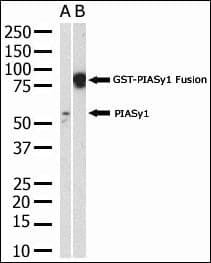
The anti-PIASy polyclonal antibody is used in Western blot to detect PIASy in HL-60 cell lysate.
PIAS4 / PIASY Antibody (aa48-79)
Primary AntibodyLSBio Guarantee
| Antibody: | Rabbit Polyclonal |
| Applications: | Immunohistochemistry (general), Immunohistochemistry, Paraffin, Western Blot |
| Reactivity: | Human |
| Format: | Liquid |
$401.00each
Catalog Number: LS-C98800-400
Catalog Number: LS-C98800
For bulk orders or custom formulations:
Request a QuoteOverview
- Description
- PIASY antibody LS-C98800 is an unconjugated rabbit polyclonal antibody to human PIASY (PIAS4) (aa48-79). Validated for IHC and WB. Cited in 1 publication.
- Application
- IHC, IHC-P, WB
- Reactivity
- Hu
- Intended Use
- Research Use Only
- Guarantees
- This antibody carries the LSBio 100% Guarantee. ✓
- Category
- Antibodies > Primary Antibodies > Polyclonal Antibodies
- Alternative Names
- E3 SUMO-protein ligase PIAS4 | PIAS-gamma | ZMIZ6 | PIAS4 | Piasg | PIASY
- UniProt Number
- Q8N2W9
- NCBI GenBank
- NM_015897 | NP_056981.2
- SwissProt
- Q8N2W9
Recommended Dilution
| Application | Dilution |
|---|---|
| IHC-P | 1:50 - 1:100 |
| WB | 1:1000 |
Target
- Target
- Human PIAS4 / PIASY
- Antigen Species
- Human
- Epitope
- This PIASy antibody is generated from rabbits immunized with a KLH conjugated synthetic peptide between 48-79 amino acids from the N-terminal region of human PIASy.
- Gene Name
- PIAS4
Antibody
- Host Species
- Rabbit
- Clonality
- Polyclonal
- Origin Species
- Human
Immunogen
- Immunogen Type
- Synthetic Peptide (Linear)
Format
- Conjugate/Label
- Unconjugated
- Format
- Liquid
- Formulation
- PBS, 0.09% Sodium Azide
- Volume
- 400 Microliter
- Preservative
- Yes
- Purification Method
- Ammonium Sulfate Precipitation
Storage & Handling
- Storage Conditions
- Maintain refrigerated at 2°C to 8°C for up to 6 months. For long term storage store at -20°C.
- Recommended Storage Buffer
- PBS
The class III kinase Vps34 promotes T lymphocyte survival through regulating IL-7R surface expression. McLeod IX, Zhou X, Li QJ, Wang F, He YW. Journal of immunology (Baltimore, Md. : 1950). 2011;187:5051-61. PubMed: 22021616 PMC: PMC3248807