
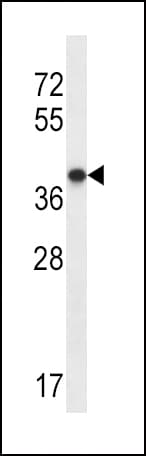
P2RY1 Antibody western blot of NCI-H292 cell line lysates (35 ug/lane). The P2RY1 antibody detected the P2RY1 protein (arrow).
P2RY1 / P2Y1 Antibody (aa231-260)
Primary AntibodyLSBio Guarantee
| Antibody: | Rabbit Polyclonal |
| Applications: | Immunohistochemistry (general), Western Blot |
| Reactivity: | Human |
| Format: | Liquid |
$401.00each
Catalog Number: LS-C163318-400
Catalog Number: LS-C163318
For bulk orders or custom formulations:
Request a QuoteOverview
- Description
- P2Y1 antibody LS-C163318 is an unconjugated rabbit polyclonal antibody to human P2Y1 (P2RY1) (aa231-260). Validated for WB. Cited in 1 publication.
- Application
- IHC, WB
- Reactivity
- Hu
- Predicted Reactivity
- Bov, Ck, Rt
- Intended Use
- RUO
- Guarantees
- This antibody carries the LSBio 100% Guarantee. ✓
- Category
- Antibodies > Primary Antibodies > Polyclonal Antibodies
- Alternative Names
- ATP receptor | p2Y1 | p2y1r | Platelet ADP receptor | Purinoceptor p2y1 | Purinergic receptor | p2 purinoceptor subtype Y1 | p2RY1 | p2Y purinoceptor 1 | p2y-1-r | Purinoceptor p2yr1 | p2y1 receptor | P2YR | Purinergic receptor P2Y, G-protein coupled, 1
- Recommended Dilution: WB
- 1:1000
- UniProt Number
- P47900
- NCBI GenBank
- NM_002563, NP_002554.1
- SwissProt
- P47900
Target
- Target
- Human P2RY1 / P2Y1
- Antigen Species
- Hu
- Epitope
- This P2RY1 antibody is generated from rabbits immunized with a KLH conjugated synthetic peptide between 231-260 amino acids from the Central region of human P2RY1.
- Gene Name
- P2RY1
Antibody
- Host Species
- Rb
- Clonality
- Polyclonal
Immunogen
- Immunogen Type
- Pep
Format
- Conjugate/Label
- Unconj
- Format
- Liquid
- Formulation
- PBS, 0.09% Sodium Azide
- Volume
- 400 Microliter
- Preservative
- Yes
- Purification Method
- Prot A
Storage & Handling
- Storage Conditions
- Maintain refrigerated at 2°C to 8°C for up to 6 months. For long term storage store at -20°C.
- Recommended Storage Buffer
- PBS
ß-Nicotinamide Adenine Dinucleotide (ß-NAD) Inhibits ATP-Dependent IL-1ß Release from Human Monocytic Cells. Hiller SD, Heldmann S, Richter K, Jurastow I, Küllmar M, Hecker A, Wilker S, Fuchs-Moll G, Manzini I, Schmalzing G, Kummer W, Padberg W, McIntosh JM, Damm J, Zakrzewicz A, Grau V. International journal of molecular sciences. 2018 April;19:pii: E1126. PubMed: 29642561 PMC: PMC5979475