
NGFR / CD271 / TNR16 Antibody (clone 25-8)
Primary AntibodyLSBio Guarantee
| Antibody: | Rat Monoclonal |
| Applications: | Flow Cytometry, Immunohistochemistry (general) |
| Reactivity: | Mouse |
| Format: | Liquid |
$434.00each
Catalog Number: LS-C179536-100
Catalog Number: LS-C179536
For bulk orders or custom formulations:
Request a QuoteOverview
- Description
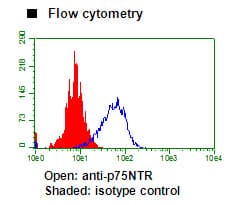
- TNR16 antibody LS-C179536 is an unconjugated rat monoclonal antibody to mouse TNR16 (NGFR / CD271). Validated for Flow. Cited in 1 publication.
- Application
- FC, IHC
- Reactivity
- Ms
- Intended Use
- Research Use Only
- Guarantees
- This antibody carries the LSBio 100% Guarantee. ✓
- Category
- Antibodies > Primary Antibodies > Monoclonal Antibodies
- Alternative Names
- CD271 | CD271 antigen | gp80-LNGFR | Nerve growth factor receptor | p75 ICD | p75(NTR) | p75NTR | TNFR superfamily, member 16 | NGF receptor | NGFR | TNFRSF16 | p75-NTR
- Recommended Dilution: FC
- 10 ug/ml
- UniProt Number
- P08138
- NCBI GenBank
- NM_002507 | NP_002498.1
- SwissProt
- P08138
Target
- Target
- Mouse NGFR / CD271 / TNR16
- Antigen Species
- Mouse
- Epitope
- Mouse P75NTR / NGFR
- Gene Name
- NGFR
Antibody
- Host Species
- Rat
- Clonality
- Monoclonal
- Clone
- 25-8
- Isotype
- IgG2a
Immunogen
- Immunogen
- Mouse fetal liver cells
- Immunogen Type
- Cell-Based Immunization
Format
- Conjugate/Label
- Unconjugated
- Format
- Liquid
- Formulation
- PBS, pH 7.2, 50% Glycerol, No preservatives added
- Concentration
- 1 mg/mL
- Volume
- 100 Microliter
- Preservative
- No
Storage & Handling
- Storage Conditions
- Store at -20°C.
- Recommended Storage Buffer
- PBS
Stress-Induced Changes in Bone Marrow Stromal Cell Populations Revealed through Single-Cell Protein Expression Mapping. Nicolas Severe, Nezihi Murat Karabacak, Karin Gustafsson, Ninib Baryawno, Gabriel Courties, Youmna Kfoury, Konstantinos D Kokkaliaris, Catherine Rhee, Dongjun Lee, Elizabeth W Scadden, Juan Esteban Garcia-Robledo, Thomas Brouse, Matthias Nahrendorf, Mehmet Toner, David T Scadden. Cell stem cell. 2019 October;25:570-583.e7. PubMed: 31279774 PMC: PMC6778015