
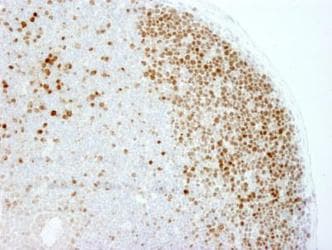
Ki67 Antibody - FFPE section of mouse Peyer's patch. Antibody: Affinity purified rabbit anti-mouse Ki-67 used at a dilution of 1:250. Detection: DAB staining using Immunohistochemistry Accessory Kit. Epitope Retrieval Buffer-High pH was substituted for Epitope Retrieval Buffer-Reduced pH. This image was taken for the unconjugated form of this product. Other forms have not been tested.
MKI67 / Ki67 Antibody (Internal)
Primary AntibodyLSBio Guarantee
| Antibody: | Rabbit Polyclonal |
| Applications: | Flow Cytometry, Immunocytochemistry, Immunohistochemistry (general), Immunohistochemistry, Paraffin |
| Reactivity: | Human, Mouse, Rat |
| Format: | Liquid |
$394.00each
Catalog Number: LS-C141898-0.1
Catalog Number: LS-C141898
For bulk orders or custom formulations:
Request a QuoteOverview
- Description
- Ki67 antibody LS-C141898 is an unconjugated rabbit polyclonal antibody to Ki67 (MKI67) (Internal) from mouse. It is reactive with human, mouse and rat. Validated for Flow, ICC and IHC. Cited in 3 publications.
- Application
- FC, ICC, IHC, IHC-P
- Reactivity
- Hu, Ms, Rt
- Intended Use
- RUO
- Guarantees
- This antibody carries the LSBio 100% Guarantee. ✓
- Category
- Antibodies > Primary Antibodies > Polyclonal Antibodies
- Alternative Names
- Antigen KI-67 | Ki67 | KIA | MKI67
- Recommended Dilution: FC
- 1:100
- Recommended Dilution: IF/ICC
- 1:100
- Recommended Dilution: IHC-P
- 1:100
- UniProt Number
- P46013
- NCBI GenBank
- NM_002417, NP_002408.3
- SwissProt
- P46013
Target
- Target
- Mouse MKI67 / Ki67
- Antigen Species
- Ms
- Gene Name
- MKI67
Antibody
- Host Species
- Rb
- Clonality
- Polyclonal
Immunogen
- Immunogen
- Synthetic peptide made to an internal portion of the mouse protein (within residues 1600-1700). [Swiss-Prot# Q61769]
- Immunogen Type
- SP-Lin
Format
- Conjugate/Label
- Unconj
- Format
- Liquid
- Formulation
- PBS, 0.05% Sodium Azide
- Concentration
- 1 mg/mL
- Volume
- 0.1 Milliliter
- Preservative
- Yes
- Purification Method
- AP
Storage & Handling
- Storage Conditions
- Short term: store at 4°C. Long term: store at -20°C. Avoid freeze-thaw cycles.
- Recommended Storage Buffer
- PBS
Nod-like receptors are critical for gut-brain axis signalling in mice. Matteo M Pusceddu, Mariana Barboza, Ciara E Keogh, Melinda Schneider, Patricia Stokes, Jessica A Sladek, Hyun Jung D Kim, Cristina Torres-Fuentes, Lily R Goldfild, Shane E Gillis, Ingrid Brust-Mascher, Gonzalo Rabasa, Kyle A Wong, Carlito Lebrilla, Mariana X Byndloss, Charles Maisonneuve, Andreas J Bäumler, Dana J Philpott, Richard L Ferrero, Kim E Barrett, Colin Reardon, Mélanie G Gareau. The Journal of physiology. 2019 December;597:5777-5797. PubMed: 31652348 PMC: PMC6911019