
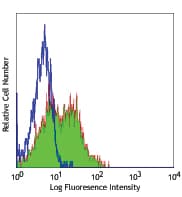
Human peripheral blood lymphocytes stained with purified FIB504, followed by anti-mouse IgG FITC
ITGB7 / Integrin Beta 7 Antibody (clone FIB504)
Primary AntibodyLSBio Guarantee
| Antibody: | Rat Monoclonal |
| Applications: | Flow Cytometry, Immunohistochemistry (general) |
| Reactivity: | Human, Mouse |
| Format: | Liquid |
$291.00each
Catalog Number: LS-C41345-100
Catalog Number: LS-C41345
For bulk orders or custom formulations:
Request a QuoteOverview
- Description
- Integrin Beta 7 antibody LS-C41345 is an unconjugated rat monoclonal antibody to Integrin Beta 7 (ITGB7) from human. It is reactive with human and mouse. Validated for Flow. Cited in 1 publication.
- Application
- FC, IHC
- Reactivity
- Hu, Ms
- Intended Use
- RUO
- Guarantees
- This antibody carries the LSBio 100% Guarantee. ✓
- Category
- Antibodies > Primary Antibodies > Monoclonal Antibodies
- Alternative Names
- Integrin Beta 7 | Integrin beta 7 subunit | Integrin beta-7 | Integrin, beta 7 | ITGB7 | INTEGRINB7 | Integrin B7 | Integrin B 7
- UniProt Number
- P26010
- NCBI GenBank
- NM_000889, NP_000880.1
- SwissProt
- P26010
Target
- Target
- Human ITGB7 / Integrin Beta 7
- Antigen Species
- Hu
- Epitope
- TK1 cells
- Gene Name
- ITGB7
Antibody
- Host Species
- Rt
- Clonality
- Monoclonal
- Clone
- FIB504
- Isotype
- IgG2a
Immunogen
- Immunogen
- Cells
- Immunogen Type
- Cell
Format
- Conjugate/Label
- Unconj
- Format
- Liquid
- Formulation
- Phosphate-buffered solution, pH 7.2, 0.09% sodium azide.
- Preservative
- Yes
- Purification Method
- AP
Storage & Handling
- Storage Conditions
- Store at 4°C or -20°C. Avoid freeze-thaw cycles.
- Recommended Storage Buffer
- Phosphate-buffered
IL-3 induces basophil expansion in vivo by directing granulocyte-monocyte progenitors to differentiate into basophil lineage-restricted progenitors in the bone marrow and by increasing the number of basophil/mast cell progenitors in the spleen. Ohmori K, Luo Y, Jia Y, Nishida J, Wang Z, Bunting KD, Wang D, Huang H. Journal of immunology (Baltimore, Md. : 1950). 2009;182:2835-41. PubMed: 19234178 PMC: PMC2756103