
GHSR / Ghrelin Receptor Antibody (C-Terminus)
Primary AntibodyLSBio Guarantee
| Antibody: | Rabbit Polyclonal |
| Applications: | Enzyme-Linked Immunosorbent Assay, Immunohistochemistry (general), Western Blot |
| Reactivity: | Human, Mouse, Rat |
| Format: | Liquid |
$339.00each
Catalog Number: LS-C136920-100
Catalog Number: LS-C136920
For bulk orders or custom formulations:
Request a QuoteOverview
- Description
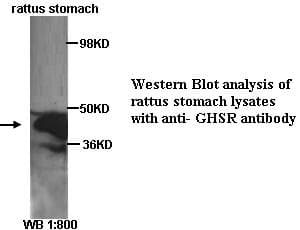
- Ghrelin Receptor antibody LS-C136920 is an unconjugated rabbit polyclonal antibody to Ghrelin Receptor (GHSR) (C-Terminus) from human. It is reactive with human, mouse and rat. Validated for ELISA and WB. Cited in 1 publication.
- Application
- ELISA, IHC, WB
- Reactivity
- Hu, Ms, Rt
- Intended Use
- RUO
- Guarantees
- This antibody carries the LSBio 100% Guarantee. ✓
- Category
- Antibodies > Primary Antibodies > Polyclonal Antibodies
- Alternative Names
- GHS receptor | GHSR | GH secretagogue receptor | GHRP | GHS-R | GH-releasing peptide receptor | Ghrelin receptor | Ghrp receptor
- Recommended Dilution: ELISA
- 1:80000
- Recommended Dilution: WB
- 1:800
- UniProt Number
- Q92847
- NCBI GenBank
- AAC50653.1, NM_198407
- SwissProt
- Q92847
Target
- Target
- Human GHSR / Ghrelin Receptor
- Antigen Species
- Hu
- Epitope
- GHSR antibody detects endogenous levels of GHSR protein. Not tested with other proteins.
- Gene Name
- GHSR
Antibody
- Host Species
- Rb
- Clonality
- Polyclonal
Immunogen
- Immunogen
- Peptide at the C-Terminus residues of human GHSR protein
- Immunogen Type
- Pep
Format
- Conjugate/Label
- Unconj
- Format
- Liquid
- Formulation
- Tris-glycine (without Mg2+, Ca2+), pH 7.4, 0.02% sodium azide, 0.5% BSA.
- Concentration
- 1 mg/mL
- Volume
- 100 Microliter
- Preservative
- Yes
- Purification Method
- Prot A
Storage & Handling
- Storage Conditions
- Store at -20°C for up to 1 year.
- Recommended Storage Buffer
- Tris-glycine
Electroacupuncture improves acute bowel injury recovery in rat models. Wu J, Lyu B, Gan T, Wang L, Zhu M. Experimental and therapeutic medicine. 2017;14:4655-4662. PubMed: 29201164