
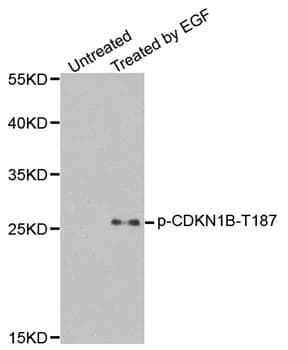
Western blot analysis of extracts from HeLa cells.
CDKN1B / p27 Kip1 Antibody (phospho-Thr187)
Primary AntibodyLSBio Guarantee
| Antibody: | Rabbit Polyclonal |
| Applications: | Immunohistochemistry (general), Western Blot |
| Format: | Liquid |
$293.00each
Catalog Number: LS-C335975-20
Catalog Number: LS-C335975
For bulk orders or custom formulations:
Request a QuoteOverview
- Description
- P27 Kip1 antibody LS-C335975 is an unconjugated rabbit polyclonal antibody to p27 Kip1 (CDKN1B) (pThr187) from human. Validated for IHC and WB. Cited in 1 publication.
- Application
- IHC, WB
- Intended Use
- Research Use Only
- Guarantees
- This antibody carries the LSBio 100% Guarantee. ✓
- Category
- Antibodies > Primary Antibodies > Polyclonal Antibodies
- Alternative Names
- CDKN1B | KIP1 | MEN1B | P27 Kip1 | p27KIP1 | MEN4 | CDKN4
- Recommended Dilution: IHC
- 1:50 - 1:100
- Recommended Dilution: WB
- 1:500 - 1:1000
- UniProt Number
- P46527
- NCBI GenBank
- NM_004064 | NP_004055.1
- SwissProt
- P46527
Target
- Target
- Human CDKN1B / p27 Kip1
- Antigen Species
- Human
- Epitope
- Human CDKN1B / p27 Kip1 pThr187
- Gene Name
- CDKN1B
Antibody
- Host Species
- Rabbit
- Clonality
- Polyclonal
- Isotype
- IgG
Immunogen
- Immunogen
- A phospho specific peptide corresponding to residues surrounding T187 of human CDKN1B.
- Immunogen Type
- Peptide
Format
- Conjugate/Label
- Unconjugated
- Format
- Liquid
- Formulation
- PBS, pH 7.3, 0.02% Sodium Azide, 50% Glycerol
- Volume
- 20 Microliter
- Preservative
- Yes
- Purification Method
- Affinity Purified
Storage & Handling
- Storage Conditions
- Store at -20°C. Avoid freeze-thaw cycles.
- Recommended Storage Buffer
- PBS
Dasatinib, a small molecule inhibitor of the Src kinase, reduces the growth and activates apoptosis in pre-neoplastic Barrett's esophagus cell lines: evidence for a noninvasive treatment of high-grade dysplasia. Landon J Inge, Aaron J Fowler, Kimberly M Paquette, Amanda L Richer, Nhan Tran, Ross M Bremner. The Journal of thoracic and cardiovascular surgery. 2013 February;145:531-8. PubMed: 23142123