
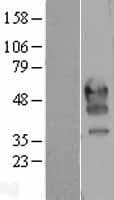
Western validation with an anti-DDK antibody * L: Control HEK293 lysate R: Over-expression lysate
PDCD1 / CD279 / PD-1 Protein (Over-Expression Lysate Myc-DDK (Flag))
ProteinLSBio Guarantee
| Expression System | Human Embryonic Kidney 293 |
| Format: | Liquid |
$504.00each
Catalog Number: LS-G100440-100
Catalog Number: LS-G100440
For bulk orders or custom formulations:
Request a QuoteOverview
- Description
- This product includes lysate of HEK293T cells that have been transiently-tranfected with Human PD1(PDCD1) (NM_005018), cells transfected with the vector alone, and a reducing buffer for SDS-Page gel loading. Cells were lysed using Modified RIPA buffer (25mM Tris-HCl pH7.6, 150mM NaCl, 1% NP-40, 1mM EDTA, 1xProteinase inhibitor cocktail mix, 1mM PMSF and 1mM Na3VO4).
- Category
- Proteins & Peptides > Proteins > Lysates
- Alternative Names
- CD279 | HPD-1 | HPD-l | PD1 | PDCD1 | Protein PD-1 | SLEB2 | PD-1 | CD279 antigen | Programmed cell death 1
- Origin Species
- Human
- NCBI GenBank
- NM_005018
- SwissProt
- Q15116
Protein
- Expression System
- Human Embryonic Kidney 293
- Fusion Tag
- c-Myc Epitope Tag (EQKLISEEDL), FLAG Octapeptide Tag (DYKDDDDK)
- Molecular Weight
- 31.65 kDa
- Protein Type
- Lysate
- Amino Acid Sequence
1MQIPQAPWPV VWAVLQLGWR PGWFLDSPDR PWNPPTFSPA LLVVTEGDNA TFTCSFSNTS61ESFVLNWYRM SPSNQTDKLA AFPEDRSQPG QDCRFRVTQL PNGRDFHMSV VRARRNDSGT121YLCGAISLAP KAQIKESLRA ELRVTERRAE VPTAHPSPSP RPAGQFQTLV VGVVGGLLGS181LVLLVWVLAV ICSRAARGTI GARRTGQPLK EDPSAVPVFS VDYGELDFQW REKTPEPPVP241CVPEQTEYAT IVFPSGMGTS SPARRGSADG PRSAQPLRPE DGHCSWPLTRTRPLEQKLISEEDLAANDILDYKDDDDKV
288 aa + 31 aa (cloning site & tags)
Format
- Purity
- Unpurified
- Conjugate/Label
- Unconjugated
- Endotoxin Level
- Not Tested
- Format
- Liquid
- Formulation
- 25mM Tris-HCl pH7.6, 150mM NaCl, 1% NP-40, 1mM EDTA, 1xProteinase inhibitor cocktail mix, 1mM PMSF and 1mM Na3VO4.
- Concentration
- 1 mg/mL
Storage & Handling
- Storage Conditions
- Store at -80°C. Avoid freeze-thaw cycles. After incubation with SDS-PAGE sample buffer, SDS-PAGE samples need to be stored in -20°C for long term storage.