
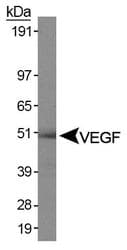
VEGF Antibody (VG76e) - Western blot of VEGF in human kidney protein. This image was taken for the unconjugated form of this product. Other forms have not been tested.
VEGFA / VEGF Antibody (clone VG76e)
Primary AntibodyLSBio Guarantee
| Antibody: | Mouse Monoclonal |
| Applications: | Immunohistochemistry (general), Immunohistochemistry, Paraffin, Western Blot |
| Reactivity: | Bovine, Human, Pig, Rat, Sheep |
| Format: | Liquid |
$394.00each
Catalog Number: LS-C2929-0.1
Catalog Number: LS-C2929
For bulk orders or custom formulations:
Request a QuoteOverview
- Description
- VEGF antibody LS-C2929 is an unconjugated mouse monoclonal antibody to VEGF (VEGFA) from human. It is reactive with human, rat, bovine and other species. Validated for IHC and WB. Cited in 2 publications.
- Application
- IHC, IHC-P, WB
- Reactivity
- Bov, Hu, Por, Rt, Sh
- Intended Use
- RUO
- Guarantees
- This antibody carries the LSBio 100% Guarantee. ✓
- Category
- Antibodies > Primary Antibodies > Monoclonal Antibodies
- Alternative Names
- VPF | Vascular permeability factor | VEGF | VEGF-A | MVCD1 | VEGFA
- Recommended Dilution: IHC-P
- 1:200
- UniProt Number
- P15692
- NCBI GenBank
- NM_003376, NP_003367.4
- SwissProt
- P15692
Target
- Target
- Human VEGFA / VEGF
- Antigen Species
- Hu
- Epitope
- VEGF.
- Gene Name
- VEGFA
Antibody
- Host Species
- Ms
- Clonality
- Monoclonal
- Clone
- VG76e
- Isotype
- IgG1
Immunogen
- Immunogen
- Human VEGF189 expressed in E. coli.
- Immunogen Type
- Recom
Format
- Conjugate/Label
- Unconj
- Format
- Liquid
- Formulation
- PBS, 0.02% Sodium Azide
- Concentration
- 1 mg/mL
- Volume
- 0.1 Milliliter
- Preservative
- Yes
- Purification Method
- Prot G
Storage & Handling
- Storage Conditions
- Short term: store at 4°C. Long term: aliquot and store at -20°C. Avoid freeze-thaw cycles.
- Recommended Storage Buffer
- PBS
Gene expression of vascular endothelial growth factor A and hypoxic adaptation in Tibetan pig. Zhang B, Qiangba Y, Shang P, Lu Y, Yang Y, Wang Z, Zhang H. Journal of animal science and biotechnology. 2016;7:21. PubMed: 27042296 PMC: PMC4818941