
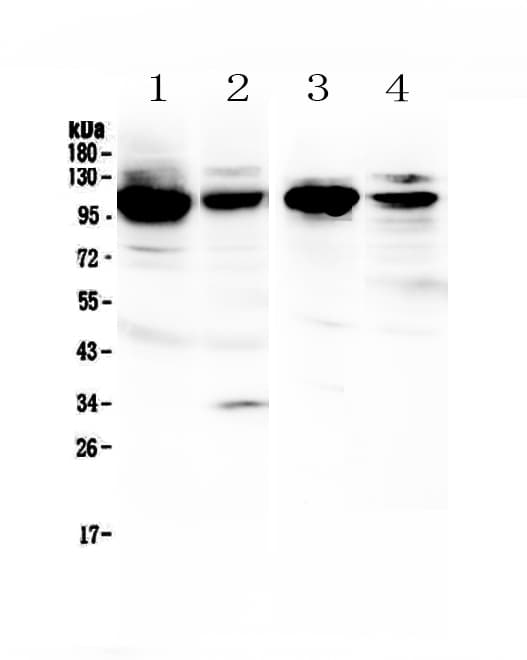
Western blot - Anti-VCAM1/Cd106 Picoband Antibody
VCAM1 / CD106 Antibody
Primary AntibodyLSBio Guarantee
| Antibody: | Rabbit Polyclonal |
| Applications: | Enzyme-Linked Immunosorbent Assay, Immunohistochemistry (general), Immunohistochemistry, Paraffin, Western Blot |
| Reactivity: | Mouse |
| Format: | Lyophilized |
$480.00each
Catalog Number: LS-C661877-100
Catalog Number: LS-C661877
For bulk orders or custom formulations:
Request a QuoteOverview
- Description
- CD106 antibody LS-C661877 is an unconjugated rabbit polyclonal antibody to mouse CD106 (VCAM1). Validated for ELISA, IHC and WB. Cited in 1 publication.
- Application
- ELISA, IHC, IHC-P, WB
- Reactivity
- Ms
- Intended Use
- RUO
- Guarantees
- This antibody carries the LSBio 100% Guarantee. ✓
- Category
- Antibodies > Primary Antibodies > Polyclonal Antibodies
- Alternative Names
- CD106 | CD106 antigen | INCAM-100 | V-CAM 1 | VCAM1 | VCAM-1
- Recommended Dilution: IHC-P
- 0.5 - 1 µg/ml
- Recommended Dilution: WB
- 0.1 - 0.5 µg/ml
- UniProt Number
- P19320
- NCBI GenBank
- NM_001078, NP_001069.1
- SwissProt
- P19320
Target
- Target
- Mouse VCAM1 / CD106
- Antigen Species
- Ms
- Epitope
- Expressed on inflamed vascular endothelium, as well as on macrophage-like and dendritic cell types in both normal and inflamed tissue. Expressed in the bone marrow.
- Gene Name
- VCAM1
Antibody
- Host Species
- Rb
- Clonality
- Polyclonal
Immunogen
- Immunogen
- E. coli-derived mouse VCAM1 recombinant protein (Position: F25-L270).
- Immunogen Type
- Recom
Format
- Conjugate/Label
- Unconj
- Format
- Lyophilized
- Formulation
- Lyophilized from 0.2mg Na2HPO4, 0.9mg NaCl, 0.05mg sodium azide, 4mg Trehalose
- Preservative
- Yes
- Purification Method
- AP
Storage & Handling
- Storage Conditions
- At -20°C for 1 year. After reconstitution, at 4°C for 1 month. It can also be aliquotted and stored frozen at -20°C for a longer time. Avoid freeze-thaw cycles.
- Recommended Storage Buffer
- NaCl
SPARC Production by Bone Marrow-Derived Cells Contributes to Myocardial Fibrosis in Pressure-Overload. Hannah J Riley, Ryan R Kelly, An O Van Laer, Lily S Neff, Shaoni Dasgupta, Catalin F Baicu, Lindsay T McDonald, Amanda C LaRue, Michael R Zile, Amy D Bradshaw. American journal of physiology. Heart and circulatory physiology. 2020 December. PubMed: 33306449