
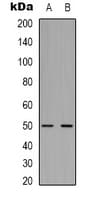
Western blot analysis of Beta2A-tubulin expression in mouse brain (A); rat brain (B) whole cell lysates.
TUBB2A / Tubulin Beta 2A Antibody
Primary AntibodyLSBio Guarantee
| Antibody: | Mouse Monoclonal |
| Applications: | Immunoprecipitation, Western Blot |
| Reactivity: | Human, Mouse, Rat |
| Format: | Liquid |
$244.00each
Catalog Number: LS-C413488-30
Catalog Number: LS-C413488
For bulk orders or custom formulations:
Request a QuoteOverview
- Description
- Tubulin Beta 2A antibody LS-C413488 is an unconjugated mouse monoclonal antibody to Tubulin Beta 2A (TUBB2A) from human. It is reactive with human, mouse and rat. Validated for IP and WB. Cited in 1 publication.
- Application
- IP, WB
- Reactivity
- Hu, Ms, Rt
- Intended Use
- RUO
- Guarantees
- This antibody carries the LSBio 100% Guarantee. ✓
- Category
- Antibodies > Primary Antibodies > Monoclonal Antibodies
- Alternative Names
- Class IIa beta-tubulin | DJ40E16.7 | TUBB2 | TUBB2A | Tubulin beta-2A chain | Tubulin, beta 2 | Tubulin, beta 2A | Tubulin, beta 2A class IIa | Beta-Tubulin | Tubulin beta-2 chain | Tubulin, beta polypeptide 2 | Tubulin, beta polypeptide
- Recommended Dilution: IP
- 1:100 - 1:200
- Recommended Dilution: WB
- 1:50000 - 1:100000
- UniProt Number
- Q13885
- NCBI GenBank
- NM_001069, NP_001060.1
- SwissProt
- Q13885
Target
- Target
- Human TUBB2A / Tubulin Beta 2A
- Antigen Species
- Hu
- Epitope
- Recognizes endogenous levels of Beta2A-tubulin protein.
- Gene Name
- TUBB2A
Antibody
- Host Species
- Ms
- Clonality
- Monoclonal
Immunogen
- Immunogen
- KLH-conjugated synthetic peptide encompassing a sequence of human Beta2A-tubulin.
- Immunogen Type
- SP-Lin
Format
- Conjugate/Label
- Unconj
- Format
- Liquid
- Formulation
- PBS, pH 7.3, 0.01% Sodium Azide, 30% Glycerol
- Volume
- 30 Microliter
- Preservative
- Yes
- Purification Method
- Other
Storage & Handling
- Storage Conditions
- Aliquot and store at -20°C for 1 year. Avoid freeze/thaw cycles.
- Recommended Storage Buffer
- PBS
Iron control of erythroid microtubule cytoskeleton as a potential target in treatment of iron-restricted anemia. Adam N Goldfarb, Katie C Freeman, Ranjit K Sahu, Kamaleldin E Elagib, Maja Holy, Abhinav Arneja, Renata Polanowska-Grabowska, Alejandro A Gru, Zollie White rd, Shadi Khalil, Michael J Kerins, Aikseng Ooi, Norbert Leitinger, Chance John Luckey, Lorrie L Delehanty. Nature communications. 2021 March;12:1645. PubMed: 33712594 PMC: PMC7955080