
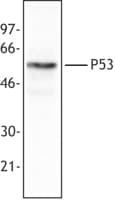
MCF-7 cell extract was resolved by electrophoresis, transferred to nitrocellulose and probed with monoclonal anti-p53 (clone BP53-12) antibody. Proteins were visualized using a goat anti-mouse secondary conjugated to HRP and a chemiluminescence detection
TP53 / p53 Antibody (clone BP53-12)
Primary AntibodyLSBio Guarantee
| Antibody: | Mouse Monoclonal |
| Applications: | Enzyme-Linked Immunosorbent Assay, Immunocytochemistry, Immunohistochemistry (general), Immunohistochemistry, Paraffin, Immunoprecipitation, Western Blot |
| Reactivity: | Human, Non-Human Primate |
| Format: | Liquid |
$282.00each
Catalog Number: LS-C41085-25
Catalog Number: LS-C41085
For bulk orders or custom formulations:
Request a QuoteOverview
- Description
- P53 antibody LS-C41085 is an unconjugated mouse monoclonal antibody to p53 (TP53) from human. It is reactive with human and primate. Validated for ELISA, ICC, IHC, IP and WB. Cited in 1 publication.
- Application
- ELISA, ICC, IHC, IHC-P, IP, WB
- Reactivity
- Hu, NHP
- Intended Use
- RUO
- Guarantees
- This antibody carries the LSBio 100% Guarantee. ✓
- Category
- Antibodies > Primary Antibodies > Monoclonal Antibodies
- Alternative Names
- BCC7 | Cellular tumor antigen p53 | p53 | TRP53 | TP53 | p53 tumor suppressor | Phosphoprotein p53 | Antigen NY-CO-13 | Tumor protein p53 | Tumor suppressor p53 | LFS1
- UniProt Number
- P04637
- NCBI GenBank
- NM_000546, NP_000537.3
- SwissProt
- P04637
Target
- Target
- Human TP53 / p53
- Antigen Species
- Hu
- Epitope
- Amino acid: 20-25 of human p53
- Gene Name
- TP53
Antibody
- Host Species
- Ms
- Clonality
- Monoclonal
- Clone
- BP53-12
- Isotype
- IgG2a
Immunogen
- Immunogen
- Synthetic peptide from human TP53 / p53.
- Immunogen Type
- SP-Lin
Format
- Conjugate/Label
- Unconj
- Format
- Liquid
- Formulation
- Tris, pH 8.0, 0.09% Sodium Azide
- Concentration
- 0.5 mg/mL
- Preservative
- Yes
- Purification Method
- AP
Storage & Handling
- Recommended Storage Buffer
- tris
Ataxia telangiectasia mutated (ATM) inhibition transforms human mammary gland epithelial cells. Mandriota SJ, Buser R, Lesne L, Stouder C, Favaudon V, Maechler P, Bna F, Clment V, Regg C, Montesano R, Sappino AP. The Journal of biological chemistry. 2010;285:13092-106. PubMed: 20177072 PMC: PMC2857118