
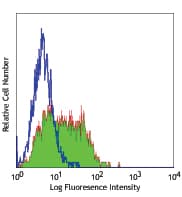
Human DR4 transfected cells stained with purified DJR1, followed by anti-mouse IgG FITC
TNFRSF10A / DR4 Antibody (Extracellular Domain, clone DJR1)
Primary AntibodyLSBio Guarantee
| Antibody: | Mouse Monoclonal |
| Applications: | Flow Cytometry, Immunohistochemistry (general) |
| Reactivity: | Human |
| Format: | Liquid |
$282.00each
Catalog Number: LS-C40989-25
Catalog Number: LS-C40989
For bulk orders or custom formulations:
Request a QuoteOverview
- Description
- DR4 antibody LS-C40989 is an unconjugated mouse monoclonal antibody to human DR4 (TNFRSF10A) (Extracellular Domain). Validated for Flow. Cited in 2 publications.
- Application
- FC, IHC
- Reactivity
- Hu
- Intended Use
- Research Use Only
- Guarantees
- This antibody carries the LSBio 100% Guarantee. ✓
- Category
- Antibodies > Primary Antibodies > Monoclonal Antibodies
- Alternative Names
- APO2 | CD261 | DR4 | TNFRSF10A | TRAIL-R1 | TRAILR-1 | TRAILR1 | TRAIL receptor 1 | CD261 antigen | Cytotoxic TRAIL receptor | Death receptor 4
- NCBI GenBank
- NM_003844
Target
- Target
- Human TNFRSF10A / DR4
- Antigen Species
- Human
- Epitope
- Extracellular domain of DR4-human IgG1 Fc fusion protein
Antibody
- Host Species
- Mouse
- Clonality
- Monoclonal
- Clone
- DJR1
- Isotype
- IgG1
Immunogen
- Immunogen
- Recombinant human TNFRSF10A / DR4.
- Immunogen Type
- Recombinant Immunogen
Format
- Conjugate/Label
- Unconjugated
- Format
- Liquid
- Formulation
- Phosphate-buffered solution, pH 7.2, 0.09% sodium azide.
- Concentration
- 0.5 mg/mL
- Preservative
- Yes
- Purification Method
- Affinity Purified
Storage & Handling
- Storage Conditions
- Store at 4°C.
- Recommended Storage Buffer
- Phosphate-buffered
Bortezomib and depsipeptide sensitize tumors to tumor necrosis factor-related apoptosis-inducing ligand: a novel method to potentiate natural killer cell tumor cytotoxicity. Lundqvist A, Abrams SI, Schrump DS, Alvarez G, Suffredini D, Berg M, Childs R. Cancer research. 2006;66:7317-25.
PubMed: 16849582
Activation of phosphatidylinositol 3-kinase/Akt signaling pathway mediates acquired resistance to sorafenib in hepatocellular carcinoma cells. Chen KF, Chen HL, Tai WT, Feng WC, Hsu CH, Chen PJ, Cheng AL. The Journal of pharmacology and experimental therapeutics. 2011;337:155-61.
PubMed: 21205925