
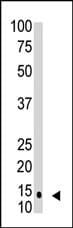
The SUMO1 monoclonal antibody is used in Western blot to detect SUMO1 in HL60 cell lysate.
SUMO1 / SMT3 Antibody (clone 66AT1273.94)
Primary AntibodyLSBio Guarantee
| Antibody: | Mouse Monoclonal |
| Applications: | Western Blot |
| Reactivity: | Human |
| Format: | Liquid |
$401.00each
Catalog Number: LS-C96460-400
Catalog Number: LS-C96460
For bulk orders or custom formulations:
Request a QuoteOverview
- Description
- SMT3 antibody LS-C96460 is an unconjugated mouse monoclonal antibody to human SMT3 (SUMO1). Validated for WB. Cited in 1 publication.
- Application
- WB
- Reactivity
- Hu
- Intended Use
- Research Use Only
- Guarantees
- This antibody carries the LSBio 100% Guarantee. ✓
- Category
- Antibodies > Primary Antibodies > Monoclonal Antibodies
- Alternative Names
- GAP modifying protein 1 | GMP1 | OFC10 | Sentrin | SMT3 homolog 3 | SMT3C | SMT3H3 | SUMO-1 | SUMO1 | Ubiquitin-like protein UBL1 | PIC1 | Ubiquitin-like 1 (sentrin) | UBL1 | DAP1 | GAP-modifying protein 1 | Ubiquitin-like protein SMT3C
- Recommended Dilution: WB
- 1:100 - 1:500
- UniProt Number
- P63165
- NCBI GenBank
- NM_003352 | NP_003343.1
- SwissProt
- P63165
Target
- Target
- Human SUMO1 / SMT3
- Antigen Species
- Human
- Epitope
- Purified recombinant GST-SUMO1 fusion protein was used as immunogen.
- Gene Name
- SUMO1
Antibody
- Host Species
- Mouse
- Clonality
- Monoclonal
- Clone
- 66AT1273.94
- Isotype
- IgG1
- Origin Species
- Human
Format
- Conjugate/Label
- Unconjugated
- Format
- Liquid
- Formulation
- PBS, 0.09% Sodium Azide
- Volume
- 400 Microliter
- Preservative
- Yes
- Purification Method
- Protein G Affinity
Storage & Handling
- Storage Conditions
- Maintain refrigerated at 2°C to 8°C for up to 6 months. For long term storage store at -20°C.
- Recommended Storage Buffer
- PBS
Insights into high affinity small ubiquitin-like modifier (SUMO) recognition by SUMO-interacting motifs (SIMs) revealed by a combination of NMR and peptide array analysis. Namanja AT, Li YJ, Su Y, Wong S, Lu J, Colson LT, Wu C, Li SS, Chen Y. The Journal of biological chemistry. 2012;287:3231-40. PubMed: 22147707 PMC: PMC3270977