
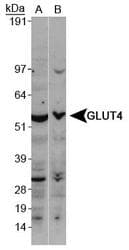
Glucose Transporter GLUT4 Antibody - Western blot of GLUT4 in A. MCF7 whole cell lysate and B. 3T3L1 whole cell lysate. This image was taken for the unconjugated form of this product. Other forms have not been tested.
SLC2A4 / GLUT-4 Antibody (aa480-509)
Primary AntibodyLSBio Guarantee
| Antibody: | Rabbit Polyclonal |
| Applications: | Immunocytochemistry, Immunofluorescence, Immunohistochemistry (general), Western Blot |
| Reactivity: | Human, Mouse, Rat |
| Format: | Liquid |
$394.00each
Catalog Number: LS-C143467-0.1
Catalog Number: LS-C143467
For bulk orders or custom formulations:
Request a QuoteOverview
- Description
- GLUT-4 antibody LS-C143467 is an unconjugated rabbit polyclonal antibody to GLUT-4 (SLC2A4) (aa480-509) from human. It is reactive with human, mouse and rat. Validated for ICC, IF, IHC and WB. Cited in 1 publication.
- Application
- ICC, IF, IHC, WB
- Reactivity
- Hu, Ms, Rt
- Intended Use
- RUO
- Guarantees
- This antibody carries the LSBio 100% Guarantee. ✓
- Category
- Antibodies > Primary Antibodies > Polyclonal Antibodies
- Alternative Names
- Glucose transporter 4 | Glucose transporter GLUT4 | GLUT4 | SLC2A4 | GLUT-4
- Recommended Dilution: IF/ICC
- 1:100
- Recommended Dilution: IHC
- 1:200
- UniProt Number
- P14672
- NCBI GenBank
- NM_001042, NP_001033.1
- SwissProt
- P14672
Target
- Target
- Human SLC2A4 / GLUT-4
- Antigen Species
- Hu
- Gene Name
- SLC2A4
Antibody
- Host Species
- Rb
- Clonality
- Polyclonal
Immunogen
- Immunogen
- A synthetic peptide made to a C-Terminus portion of the human GLUT4 protein (between residues 480-509) [UniProt P14672].
- Immunogen Type
- SP-Lin
Format
- Conjugate/Label
- Unconj
- Format
- Liquid
- Formulation
- PBS, 0.02% Sodium Azide
- Concentration
- 1 mg/mL
- Volume
- 0.1 Milliliter
- Preservative
- Yes
- Purification Method
- AP
Storage & Handling
- Storage Conditions
- Aliquot and store at -20°C or -80°C. Avoid freeze-thaw cycles.
- Recommended Storage Buffer
- PBS
Adiponectin stimulates glucose uptake in mouse blastocysts and embryonic carcinoma cells. J Burkuš, A Navarrete Santos, M Schindler, J Babelová, J S Jung, A Špirková, M Kšinanová, V Kovaríková, B Fischer, J Koppel, D Fabian, Š Cikoš. Reproduction (Cambridge, England). 2020 March;159:227-239. PubMed: 32023207