
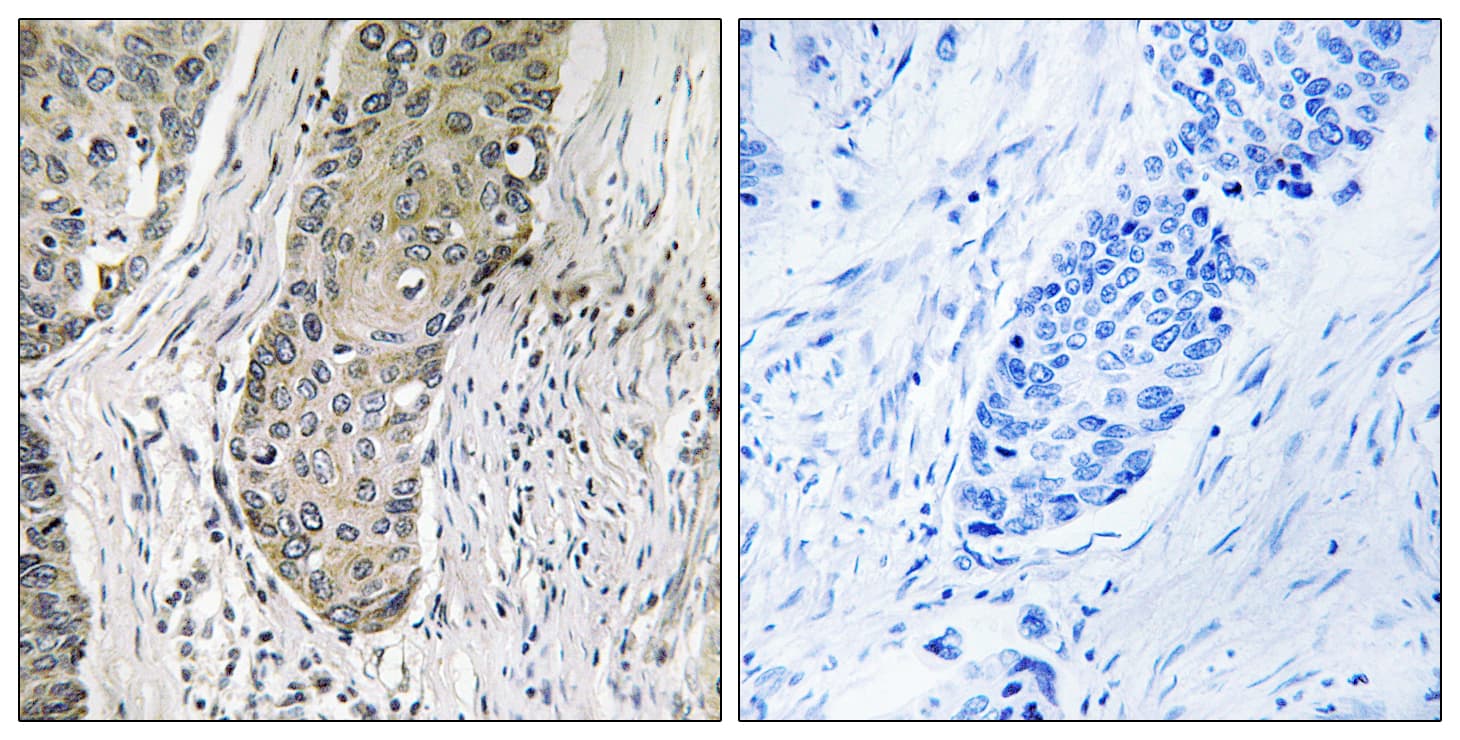
Immunohistochemistry analysis of paraffin-embedded human lung carcinoma tissue, using QSK Antibody. The picture on the right is blocked with the synthesized peptide.
SIK3 / QSK Antibody (aa521-570)
Primary AntibodyLSBio Guarantee
| Antibody: | Rabbit Polyclonal |
| Applications: | Enzyme-Linked Immunosorbent Assay, Immunohistochemistry (general), Immunohistochemistry, Paraffin, Western Blot |
| Reactivity: | Human, Mouse |
| Format: | Liquid |
$341.00each
Catalog Number: LS-C120369-50
Catalog Number: LS-C120369
For bulk orders or custom formulations:
Request a QuoteOverview
- Description
- QSK antibody LS-C120369 is an unconjugated rabbit polyclonal antibody to QSK (SIK3) (aa521-570) from human. It is reactive with human and mouse. Validated for IHC and Peptide-ELISA. Cited in 1 publication.
- Application
- ELISA, IHC, IHC-P, WB
- Reactivity
- Hu, Ms
- Intended Use
- Research Use Only
- Guarantees
- This antibody carries the LSBio 100% Guarantee. ✓
- Category
- Antibodies > Primary Antibodies > Polyclonal Antibodies
- Alternative Names
- KIAA0999 | L19 | QSK | Salt-inducible kinase 3 | SIK-3 | SIK3 | SIK family kinase 3
- UniProt Number
- Q9Y2K2
- NCBI GenBank
- NM_025164
- SwissProt
- Q9Y2K2
Target
- Target
- Human SIK3 / QSK
- Antigen Species
- Human
- Epitope
- QSK Antibody detects endogenous levels of total QSK protein.
- Gene Name
- SIK3
Antibody
- Host Species
- Rabbit
- Clonality
- Polyclonal
- Isotype
- IgG
Immunogen
- Immunogen
- Synthetic peptide from human QSK. (AA Range: 521-570)
- Immunogen Type
- Synthetic Peptide (Linear)
Format
- Conjugate/Label
- Unconjugated
- Format
- Liquid
- Formulation
- PBS (without Mg2+, Ca2+), pH 7.4, 150 mM NaCl, 0.02% Sodium Azide, 50% Glycerol
- Concentration
- 1 mg/mL
- Volume
- 50 Microliter
- Preservative
- Yes
- Purification Method
- Affinity Purified
Storage & Handling
- Storage Conditions
- Store at -20°C for up to 1 year.
- Recommended Storage Buffer
- PBS|150 mM NaCl
Salt-inducible kinase 3, SIK3, is a new gene associated with hearing. Wolber LE, Girotto G, Buniello A, Vuckovic D, Pirastu N, Lorente-Cánovas B, Rudan I, Hayward C, Polasek O, Ciullo M, Mangino M, Steves C, Concas MP, Cocca M, Spector TD, Gasparini P, Steel KP, Williams FM. Human molecular genetics. 2014;23:6407-18. PubMed: 25060954 PMC: PMC4222365