
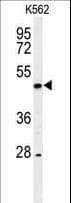
Western blot of hRIPK3-E504 in K562 cell line lysates (35 ug/lane). RIPK3 (arrow) was detected using the purified antibody.
RIPK3 / RIP3 Antibody (aa489-518)
Primary AntibodyLSBio Guarantee
| Antibody: | Rabbit Polyclonal |
| Applications: | Immunohistochemistry (general), Western Blot |
| Reactivity: | Human, Mouse |
| Format: | Liquid |
$401.00each
Catalog Number: LS-C97217-400
Catalog Number: LS-C97217
For bulk orders or custom formulations:
Request a QuoteOverview
- Description
- RIP3 antibody LS-C97217 is an unconjugated rabbit polyclonal antibody to RIP3 (RIPK3) (aa489-518) from human. It is reactive with human and mouse. Validated for IHC and WB. Cited in 1 publication.
- Application
- IHC, WB
- Reactivity
- Hu, Ms
- Intended Use
- RUO
- Guarantees
- This antibody carries the LSBio 100% Guarantee. ✓
- Category
- Antibodies > Primary Antibodies > Polyclonal Antibodies
- Alternative Names
- Receptor interacting protein 3 | RIPK3 | RIP-like protein kinase 3 | RIP3 | RIP-3 | Receptor-interacting protein 3
- Recommended Dilution: WB
- 1:1000
- UniProt Number
- Q9Y572
- NCBI GenBank
- NM_006871, NP_006862.2
- SwissProt
- Q9Y572
Target
- Target
- Human RIPK3 / RIP3
- Antigen Species
- Hu
- Epitope
- This RIPK3 antibody is generated from rabbits immunized with a KLH conjugated synthetic peptide between 489-518 amino acids from the C-terminal region of human RIPK3.
- Gene Name
- RIPK3
Antibody
- Host Species
- Rb
- Clonality
- Polyclonal
- Origin Species
- Hu
Immunogen
- Immunogen Type
- SP-Lin
Format
- Conjugate/Label
- Unconj
- Format
- Liquid
- Formulation
- PBS, 0.09% Sodium Azide
- Concentration
- 2 mg/mL
- Volume
- 400 Microliter
- Preservative
- Yes
- Purification Method
- AS Ppt
Storage & Handling
- Storage Conditions
- Maintain refrigerated at 2°C to 8°C for up to 6 months. For long term storage store at -20°C.
- Recommended Storage Buffer
- PBS
The effects and regulatory mechanism of RIP3 on RGC-5 necroptosis following elevated hydrostatic pressure. Shang L, Ding W, Li N, Liao L, Chen D, Huang J, Xiong K. Acta biochimica et biophysica Sinica. 2017 February;49:128-137. PubMed: 28039150