
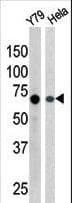
The anti-Phospho-Rad9-S387 antibody is used in Western blot to detect Phospho-Rad9-S387 in Y79 (left) and HeLa (right) tissue lysate
RAD9A / RAD9 Antibody (phospho-Ser387)
Primary AntibodyLSBio Guarantee
| Antibody: | Rabbit Polyclonal |
| Applications: | Immunohistochemistry (general), Immunohistochemistry, Paraffin, Western Blot |
| Reactivity: | Human |
| Format: | Liquid |
$401.00each
Catalog Number: LS-C96952-400
Catalog Number: LS-C96952
For bulk orders or custom formulations:
Request a QuoteOverview
- Description
- RAD9 antibody LS-C96952 is an unconjugated rabbit polyclonal antibody to human RAD9 (RAD9A) (pSer387). Validated for IHC and WB. Cited in 1 publication.
- Application
- IHC, IHC-P, WB
- Reactivity
- Hu
- Predicted Reactivity
- NHP
- Intended Use
- RUO
- Guarantees
- This antibody carries the LSBio 100% Guarantee. ✓
- Category
- Antibodies > Primary Antibodies > Polyclonal Antibodies
- Alternative Names
- HRAD9 | RAD9 | RAD9 homolog | RAD9 (S. pombe) homolog | RAD9 homolog A (S. pombe) | RAD9A
- Recommended Dilution: IHC-P
- 1:50 - 1:100
- Recommended Dilution: WB
- 1:1000
- UniProt Number
- Q99638
- NCBI GenBank
- NM_004584, NP_004575.1
- SwissProt
- Q99638
Target
- Target
- Human RAD9A / RAD9
- Antigen Species
- Hu
- Epitope
- This RAD9 Antibody is generated from rabbits immunized with a KLH conjugated synthetic phosphopeptide corresponding to amino acid residues surrounding S387 of human RAD9.
- Gene Name
- RAD9A
Antibody
- Host Species
- Rb
- Clonality
- Polyclonal
- Origin Species
- Hu
Immunogen
- Immunogen Type
- SP-Lin
Format
- Conjugate/Label
- Unconj
- Format
- Liquid
- Formulation
- PBS, 0.09% Sodium Azide
- Volume
- 400 Microliter
- Preservative
- Yes
- Purification Method
- Prot A
Storage & Handling
- Storage Conditions
- Maintain refrigerated at 2°C to 8°C for up to 6 months. For long term storage store at -20°C.
- Recommended Storage Buffer
- PBS
The basic cleft of RPA70N binds multiple checkpoint proteins, including RAD9, to regulate ATR signaling. Xu X, Vaithiyalingam S, Glick GG, Mordes DA, Chazin WJ, Cortez D. Molecular and cellular biology. 2008;28:7345-53. PubMed: 18936170 PMC: PMC2593429