
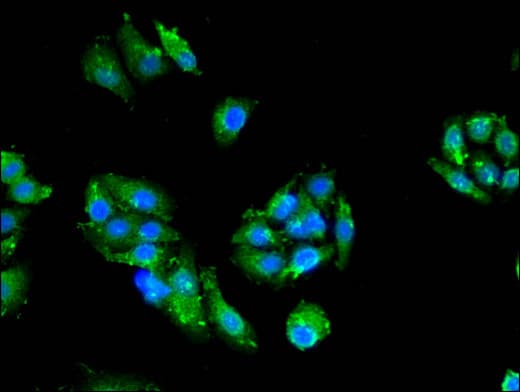
Immunofluorescent analysis of HepG2 cells using PRKCZ Antibody at a dilution of 1:100 and Alexa Fluor 488-congugated AffiniPure Goat Anti-Rabbit IgG(H+L)
PRKCZ / PKC-Zeta Antibody
Primary AntibodyLSBio Guarantee
| Antibody: | Rabbit Polyclonal |
| Applications: | Enzyme-Linked Immunosorbent Assay, Immunofluorescence |
| Reactivity: | Human |
| Format: | Liquid |
$300.00each
Catalog Number: LS-C500310-50
Catalog Number: LS-C500310
For bulk orders or custom formulations:
Request a QuoteOverview
- Description
- PKC-Zeta antibody LS-C500310 is an unconjugated rabbit polyclonal antibody to human PKC-Zeta (PRKCZ). Validated for ELISA and IF.
- Application
- ELISA, IF
- Reactivity
- Hu
- Intended Use
- RUO
- Guarantees
- This antibody carries the LSBio 100% Guarantee. ✓
- Category
- Antibodies > Primary Antibodies > Polyclonal Antibodies
- Alternative Names
- PKC-ZETA | PKC2 | Pkcz | PKCzeta | Protein kinase c zeta | Protein kinase C zeta type | NPKC-zeta | PKC Zeta | PRKCZ | Protein kinase C, zeta | Protein kinase Czeta
- UniProt Number
- Q05513
- NCBI GenBank
- NM_002744, NP_002735.3
- SwissProt
- Q05513
Target
- Target
- Human PRKCZ / PKC-Zeta
- Antigen Species
- Hu
- Epitope
- Calcium- and diacylglycerol-independent serine/threonine-protein kinase that functions in phosphatidylinositol 3-kinase (PI3K) pathway and mitogen-activated protein (MAP) kinase cascade, and is involved in NF-kappa-B activation, mitogenic signaling, cell proliferation, cell polarity, inflammatory response and maintenance of long-term potentiation (LTP). Upon lipopolysaccharide (LPS) treatment in macrophages, or following mitogenic stimuli, functions downstream of PI3K to activate MAP2K1/MEK1-MAPK1/ERK2 signaling cascade independently of RAF1 activation. Required for insulin-dependent activation of AKT3, but may function as an adapter rather than a direct activator. Upon insulin treatment may act as a downstream effector of PI3K and contribute to the activation of translocation of the glucose transporter SLC2A4/GLUT4 and subsequent glucose transport in adipocytes. In EGF-induced cells, binds and activates MAP2K5/MEK5-MAPK7/ERK5 independently of its kinase activity and can activate JUN promoter through MEF2C. Through binding with SQSTM1/p62, functions in interleukin-1 signaling and activation of NF-kappa-B with the specific adapters RIPK1 and TRAF6. Participates in TNF-dependent transactivation of NF-kappa-B by phosphorylating and activating IKBKB kinase, which in turn leads to the degradation of NF-kappa-B inhibitors. In migrating astrocytes, forms a cytoplasmic complex with PARD6A and is recruited by CDC42 to function in the establishment of cell polarity along with the microtubule motor and dynein. In association with FEZ1, stimulates neuronal differentiation in PC12 cells. In the inflammatory response, is required for the T-helper 2 (Th2) differentiation process, including interleukin production, efficient activation of JAK1 and the subsequent phosphorylation and nuclear translocation of STAT6. May be involved in development of allergic airway inflammation (asthma), a process dependent on Th2 immune response. In the NF-kappa-B-mediated inflammatory response, can relieve SETD6-dependent repression of NF-kappa-B target genes by phosphorylating the RELA subunit at 'Ser-311'. Necessary and sufficient for LTP maintenance in hippocampal CA1 pyramidal cells. In vein endothelial cells treated with the oxidant peroxynitrite, phosphorylates STK11 leading to nuclear export of STK11, subsequent inhibition of PI3K/Akt signaling, and increased apoptosis. Phosphorylates VAMP2 in vitro (PubMed:17313651).
- Gene Name
- PRKCZ
Antibody
- Host Species
- Rb
- Clonality
- Polyclonal
- Isotype
- IgG
Immunogen
- Immunogen
- Recombinant Human Protein kinase C zeta type protein (494-575AA)
- Immunogen Type
- Recom
Format
- Conjugate/Label
- Unconj
- Format
- Liquid
- Formulation
- PBS, pH 7.4, 0.03% Proclin 300, 50% glycerol.
- Preservative
- Yes
- Purification Method
- Prot G
Storage & Handling
- Storage Conditions
- Short term: -20°C; Long term: -80°C; Avoid freeze-thaw cycles.
- Recommended Storage Buffer
- PBS