
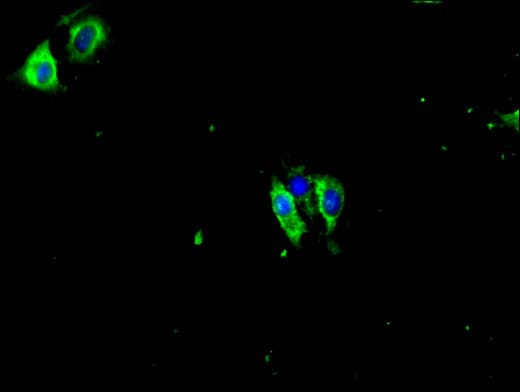
Immunofluorescent analysis of Hela cells using PRKCG Antibody at a dilution of 1:100 and Alexa Fluor 488-congugated AffiniPure Goat Anti-Rabbit IgG(H+L)
PRKCG / PKC-Gamma Antibody
Primary AntibodyLSBio Guarantee
| Antibody: | Rabbit Polyclonal |
| Applications: | Enzyme-Linked Immunosorbent Assay, Immunofluorescence |
| Reactivity: | Human |
| Format: | Liquid |
$300.00each
Catalog Number: LS-C500315-50
Catalog Number: LS-C500315
For bulk orders or custom formulations:
Request a QuoteOverview
- Description
- PKC-Gamma antibody LS-C500315 is an unconjugated rabbit polyclonal antibody to human PKC-Gamma (PRKCG). Validated for ELISA and IF.
- Application
- ELISA, IF
- Reactivity
- Hu
- Intended Use
- Research Use Only
- Guarantees
- This antibody carries the LSBio 100% Guarantee. ✓
- Category
- Antibodies > Primary Antibodies > Polyclonal Antibodies
- Alternative Names
- PKC-gamma | PRKC-gamma | Protein kinase C gamma | PRKCG | Protein kinase C gamma type | PKC Gamma | PKCC | PKCG | Pkcgamma | Protein kinase C, gamma | SCA14
- UniProt Number
- P05129
- NCBI GenBank
- NM_002739 | NP_002730.1
- SwissProt
- P05129
Target
- Target
- Human PRKCG / PKC-Gamma
- Antigen Species
- Human
- Epitope
- Calcium-activated, phospholipid- and diacylglycerol (DAG)-dependent serine/threonine-protein kinase that plays diverse roles in neuronal cells and eye tissues, such as regulation of the neuronal receptors GRIA4/GLUR4 and GRIN1/NMDAR1, modulation of receptors and neuronal functions related to sensitivity to opiates, pain and alcohol, mediation of synaptic function and cell survival after ischemia, and inhibition of gap junction activity after oxidative stress. Binds and phosphorylates GRIA4/GLUR4 glutamate receptor and regulates its function by increasing plasma membrane-associated GRIA4 expression. In primary cerebellar neurons treated with the agonist 3,5-dihyidroxyphenylglycine, functions downstream of the metabotropic glutamate receptor GRM5/MGLUR5 and phosphorylates GRIN1/NMDAR1 receptor which plays a key role in synaptic plasticity, synaptogenesis, excitotoxicity, memory acquisition and learning. May be involved in the regulation of hippocampal long-term potentiation (LTP), but may be not necessary for the process of synaptic plasticity. May be involved in desensitization of mu-type opioid receptor-mediated G-protein activation in the spinal cord, and may be critical for the development and/or maintenance of morphine-induced reinforcing effects in the limbic forebrain. May modulate the functionality of mu-type-opioid receptors by participating in a signaling pathway which leads to the phosphorylation and degradation of opioid receptors. May also contributes to chronic morphine-induced changes in nociceptive processing. Plays a role in neuropathic pain mechanisms and contributes to the maintenance of the allodynia pain produced by peripheral inflammation. Plays an important role in initial sensitivity and tolerance to ethanol, by mediating the behavioral effects of ethanol as well as the effects of this drug on the GABA(A) receptors. During and after cerebral ischemia modulate neurotransmission and cell survival in synaptic membranes, and is involved in insulin-induced inhibition of necrosis, an important mechanism for minimizing ischemic injury. Required for the elimination of multiple climbing fibers during innervation of Purkinje cells in developing cerebellum. Is activated in lens epithelial cells upon hydrogen peroxide treatment, and phosphorylates connexin-43 (GJA1/CX43), resulting in disassembly of GJA1 gap junction plaques and inhibition of gap junction activity which could provide a protective effect against oxidative stress (By similarity). P
- Gene Name
- PRKCG
Antibody
- Host Species
- Rabbit
- Clonality
- Polyclonal
- Isotype
- IgG
Immunogen
- Immunogen
- Recombinant Human Protein kinase C gamma type protein (1-314AA)
- Immunogen Type
- Recombinant Immunogen
Format
- Conjugate/Label
- Unconjugated
- Format
- Liquid
- Formulation
- PBS, pH 7.4, 0.03% Proclin 300, 50% glycerol.
- Preservative
- Yes
- Purification Method
- Protein G Affinity
Storage & Handling
- Storage Conditions
- Short term: -20°C; Long term: -80°C; Avoid freeze-thaw cycles.
- Recommended Storage Buffer
- PBS