
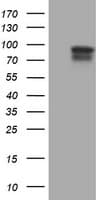
HEK293T cells were transfected with the pCMV6-ENTRY control (Left lane) or pCMV6-ENTRY SPG7 (Right lane) cDNA for 48 hrs and lysed. Equivalent amounts of cell lysates (5 ug per lane) were separated by SDS-PAGE and immunoblotted with anti-SPG7.
Paraplegin / SPG7 Antibody (clone OTI3H10)
Primary AntibodyLSBio Guarantee
| Antibody: | Mouse Monoclonal |
| Applications: | Flow Cytometry, Immunofluorescence, Immunohistochemistry (general), Western Blot |
| Reactivity: | Human |
| Format: | Liquid |
$443.00each
Catalog Number: LS-C175082-100
Catalog Number: LS-C175082
For bulk orders or custom formulations:
Request a QuoteOverview
- Description
- SPG7 antibody LS-C175082 is an unconjugated mouse monoclonal antibody to human SPG7 (Paraplegin). Validated for Flow, IF and WB. Cited in 1 publication.
- Application
- FC, IF, IHC, WB
- Reactivity
- Hu
- Intended Use
- Research Use Only
- Guarantees
- This antibody carries the LSBio 100% Guarantee. ✓
- Category
- Antibodies > Primary Antibodies > Monoclonal Antibodies
- Alternative Names
- Cell adhesion regulator | Cell matrix adhesion regulator | Paraplegin | PGN | SPG5C | SPG7 | Spastic paraplegia 7 protein | CAR | CMAR
- UniProt Number
- Q9UQ90
- NCBI GenBank
- NM_003119 | NP_003110.1
- SwissProt
- Q9UQ90
Recommended Dilution
| Application | Dilution |
|---|---|
| FC | 1:100 |
| IF/ICC | 1:100 |
| WB | 1:2000 |
Target
- Target
- Human Paraplegin / SPG7
- Antigen Species
- Human
- Epitope
- Human Paraplegin / SPG7
- Gene Name
- SPG7
Antibody
- Host Species
- Mouse
- Clonality
- Monoclonal
- Clone
- OTI3H10
- Isotype
- IgG1
Immunogen
- Immunogen
- Human recombinant protein fragment corresponding to amino acids 300-573 of human SPG7 (NP_003110) produced in E. coli.
- Immunogen Type
- Recombinant Protein Fragment
Format
- Conjugate/Label
- Unconjugated
- Format
- Liquid
- Formulation
- PBS, pH 7.3, 0.02% Sodium Azide, 50% Glycerol, 1% BSA
- Concentration
- 1 mg/mL
- Volume
- 100 Microliter
- Preservative
- Yes
- Purification Method
- Protein A/G Affinity
Storage & Handling
- Storage Conditions
- Store at -20°C. Avoid freeze-thaw cycles.
- Recommended Storage Buffer
- PBS
Impaired flickering of the permeability transition pore causes SPG7 spastic paraplegia. Irene Sambri, Filomena Massa, Francesca Gullo, Simone Meneghini, Laura Cassina, Michela Carraro, Giorgia Dina, Angelo Quattrini, Lorenzo Patanella, Annamaria Carissimo, Antonella Iuliano, Filippo Santorelli, Franca Codazzi, Fabio Grohovaz, Paolo Bernardi, Andrea Becchetti, Giorgio Casari. EBioMedicine. 2020 November;61:103050. PubMed: 33045469 PMC: PMC7553352