
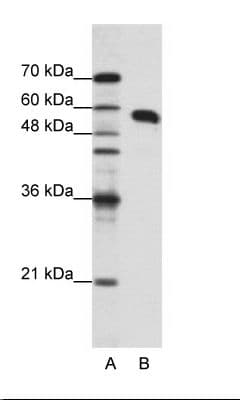
A: Marker, B: HepG2 Cell Lysate. This image was taken for the unconjugated form of this product. Other forms have not been tested.
NONO / P54NRB Antibody (N-Terminus)
Primary AntibodyLSBio Guarantee
| Antibody: | Rabbit Polyclonal |
| Applications: | Immunohistochemistry (general), Western Blot |
| Reactivity: | Human |
| Format: | Liquid |
$405.00each
Catalog Number: LS-C31127-100
Catalog Number: LS-C31127
For bulk orders or custom formulations:
Request a QuoteOverview
- Description
- P54NRB antibody LS-C31127 is an unconjugated rabbit polyclonal antibody to human P54NRB (NONO) (N-Terminus). Validated for WB. Cited in 1 publication.
- Application
- IHC, WB
- Reactivity
- Hu
- Intended Use
- RUO
- Guarantees
- This antibody carries the LSBio 100% Guarantee. ✓
- Category
- Antibodies > Primary Antibodies > Polyclonal Antibodies
- Alternative Names
- 55 kDa nuclear protein | NRB54 | NMT55 | NonO protein | p54 | p54(nrb) | p54NRB | NONO
- UniProt Number
- Q15233
- NCBI GenBank
- NM_007363, NP_031389.3
- SwissProt
- Q15233
Target
- Target
- Human NONO / P54NRB
- Antigen Species
- Hu
- Epitope
- Human NONO
- Gene Name
- NONO
Antibody
- Host Species
- Rb
- Clonality
- Polyclonal
- Isotype
- IgG
Immunogen
- Immunogen
- Synthetic peptide from N-Terminus of human NONO (Q15233, NP_031389). Percent identity by BLAST analysis: Human, Chimpanzee, Gorilla, Orangutan, Gibbon, Monkey, Galago, Marmoset, Mouse, Rat, Panda, Dog, Bat, Horse, Guinea pig (100%); Elephant, Bovine, Opossum, Zebra finch (92%); Chicken (90%).
- Immunogen Type
- SP-Lin
Format
- Conjugate/Label
- Unconj
- Format
- Liquid
- Formulation
- PBS, 0.09% sodium azide, 2% sucrose
- Concentration
- 1 mg/mL
- Volume
- 100 Microliter
- Preservative
- Yes
- Purification Method
- Prot A
Storage & Handling
- Storage Conditions
- Short term: Store at 2-8°C. Long term: Aliquot and store at -20°C. Avoid freeze/thaw cycles.
- Recommended Storage Buffer
- PBS
Mutations in NONO lead to syndromic intellectual disability and inhibitory synaptic defects. Mircsof D, Langouët M, Rio M, Moutton S, Siquier-Pernet K, Bole-Feysot C, Cagnard N, Nitschke P, Gaspar L, Žnidaric M, Alibeu O, Fritz AK, Wolfer DP, Schröter A, Bosshard G, Rudin M, Koester C, Crestani F, Seebeck P, Boddaert N, Prescott K; DDD Study, Hines R, Moss SJ, Fritschy JM, Munnich A, Amiel J, Brown SA, Tyagarajan SK, Colleaux L. Nature neuroscience. 2015;18:1731-6. PubMed: 26571461 PMC: PMC5392243