
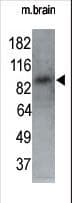
The anti-MARK1 N-term antibody is used in Western blot to detect MARK1 in P7 mouse whole brain lysate (60 ug). 1:250 dilution of anti-MARK1 antibody was used. Data and protocol kindly provided by DR. Shengli Zhao, M.D., Ph.D. of Duke University Medical Center.
MARK1 / MARK Antibody (aa6-40)
Primary AntibodyLSBio Guarantee
| Antibody: | Rabbit Polyclonal |
| Applications: | Immunohistochemistry (general), Immunohistochemistry, Paraffin, Western Blot |
| Reactivity: | Human, Mouse |
| Format: | Liquid |
$401.00each
Catalog Number: LS-C98353-400
Catalog Number: LS-C98353
For bulk orders or custom formulations:
Request a QuoteOverview
- Description
- MARK antibody LS-C98353 is an unconjugated rabbit polyclonal antibody to MARK (MARK1) (aa6-40) from human. It is reactive with human and mouse. Validated for IHC and WB. Cited in 1 publication.
- Application
- IHC, IHC-P, WB
- Reactivity
- Hu, Ms
- Intended Use
- RUO
- Guarantees
- This antibody carries the LSBio 100% Guarantee. ✓
- Category
- Antibodies > Primary Antibodies > Polyclonal Antibodies
- Alternative Names
- KIAA1477 | MARK1 | Par1c | PAR1 homolog c | MARK | Par-1c
- Recommended Dilution: IHC-P
- 1:10 - 1:50
- Recommended Dilution: WB
- 1:1000
- UniProt Number
- Q9P0L2
- NCBI GenBank
- NM_018650, NP_061120.3
- SwissProt
- Q9P0L2
Target
- Target
- Human MARK1 / MARK
- Antigen Species
- Hu
- Epitope
- This MARK1 antibody is generated from rabbits immunized with a KLH conjugated synthetic peptide between 6-40 amino acids from the N-terminal region of human MARK1.
- Gene Name
- MARK1
Antibody
- Host Species
- Rb
- Clonality
- Polyclonal
- Origin Species
- Hu
Immunogen
- Immunogen Type
- SP-Lin
Format
- Conjugate/Label
- Unconj
- Format
- Liquid
- Formulation
- PBS, 0.09% Sodium Azide
- Volume
- 400 Microliter
- Preservative
- Yes
- Purification Method
- AS Ppt
Storage & Handling
- Storage Conditions
- Maintain refrigerated at 2°C to 8°C for up to 6 months. For long term storage store at -20°C.
- Recommended Storage Buffer
- PBS
Pancreatic LKB1 deletion leads to acinar polarity defects and cystic neoplasms. Hezel AF, Gurumurthy S, Granot Z, Swisa A, Chu GC, Bailey G, Dor Y, Bardeesy N, Depinho RA. Molecular and cellular biology. 2008;28:2414-25. PubMed: 18227155 PMC: PMC2268441