
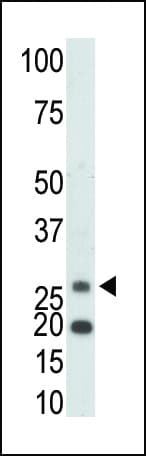
The anti-KHK antibody is used in Western blot to detect KHK in mouse kidney tissue lysate.
KHK / Ketohexokinase Antibody (aa251-281)
Primary AntibodyLSBio Guarantee
| Antibody: | Rabbit Polyclonal |
| Applications: | Western Blot |
| Reactivity: | Human, Mouse |
| Format: | Liquid |
$401.00each
Catalog Number: LS-C99011-400
Catalog Number: LS-C99011
For bulk orders or custom formulations:
Request a QuoteOverview
- Description
- Ketohexokinase antibody LS-C99011 is an unconjugated rabbit polyclonal antibody to Ketohexokinase (KHK) (aa251-281) from human. It is reactive with human and mouse. Validated for WB. Cited in 1 publication.
- Application
- WB
- Reactivity
- Hu, Ms
- Intended Use
- Research Use Only
- Guarantees
- This antibody carries the LSBio 100% Guarantee. ✓
- Category
- Antibodies > Primary Antibodies > Polyclonal Antibodies
- Alternative Names
- Ketohexokinase (fructokinase) | Hepatic fructokinase | Ketohexokinase | KHK
- UniProt Number
- P50053
- NCBI GenBank
- NM_000221 | NP_000212.1
- SwissProt
- P50053
Recommended Dilution
| Application | Dilution |
|---|---|
| WB | 1:1000 |
Target
- Target
- Human KHK / Ketohexokinase
- Antigen Species
- Human
- Epitope
- This Ketohexokinase (KHK) antibody is generated from rabbits immunized with a KLH conjugated synthetic peptide between 251-281 amino acids from the C-terminal region of human Ketohexokinase (KHK).
- Gene Name
- KHK
Antibody
- Host Species
- Rabbit
- Clonality
- Polyclonal
- Origin Species
- Human
Immunogen
- Immunogen Type
- Synthetic Peptide (Linear)
Format
- Conjugate/Label
- Unconjugated
- Format
- Liquid
- Formulation
- PBS, 0.09% Sodium Azide
- Volume
- 400 Microliter
- Preservative
- Yes
- Purification Method
- Ammonium Sulfate Precipitation
Storage & Handling
- Storage Conditions
- Maintain refrigerated at 2°C to 8°C for up to 6 months. For long term storage store at -20°C.
- Recommended Storage Buffer
- PBS
Ketohexokinase: expression and localization of the principal fructose-metabolizing enzyme. Diggle CP, Shires M, Leitch D, Brooke D, Carr IM, Markham AF, Hayward BE, Asipu A, Bonthron DT. The journal of histochemistry and cytochemistry : official journal of the Histochemistry Society. 2009;57:763-74. PubMed: 19365088 PMC: PMC2713076