
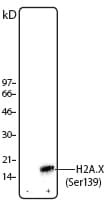
Untreated (Lane 1) and staurosporine-treated (Lane 2) Jurkat nuclear extract was resolved by electrophoresis, transferred to nitrocellulose and probed with anti-phospho-H2A. X (Ser 139) antibody. Proteins were visualized using a goat anti-mouse secondary a.
H2AFX / H2AX Antibody (phospho-Ser139, clone 2F3)
| Antibody: | Mouse Monoclonal |
| Applications: | Immunocytochemistry, Immunofluorescence, Immunohistochemistry (general), Western Blot |
| Reactivity: | Human |
| Format: | Liquid |
For bulk orders or custom formulations:
Request a QuoteOverview
- Description
- H2AX antibody LS-C41114 is an unconjugated mouse monoclonal antibody to human H2AX (H2AFX) (pSer139). Validated for ICC, IF and WB. Cited in 5 publications.
- Application
- ICC, IF, IHC, WB
- Reactivity
- Hu
- Intended Use
- Research Use Only
- Guarantees
- This antibody carries the LSBio 100% Guarantee. ✓
- Category
- Antibodies > Primary Antibodies > Monoclonal Antibodies
- Alternative Names
- H2AFX | H2AX | Histone H2A.x | H2A.X | H2A histone family, member X | H2AX histone
- UniProt Number
- P16104
- NCBI GenBank
- NM_002105 | NP_002096.1
- SwissProt
- P16104
Target
- Target
- Human H2AFX / H2AX
- Antigen Species
- Human
- Epitope
- Modified peptide (KATQAS*QEY)
- Gene Name
- H2AX
Antibody
- Host Species
- Mouse
- Clonality
- Monoclonal
- Clone
- 2F3
- Isotype
- IgG2b
Immunogen
- Immunogen
- Synthetic peptide from human H2AFX / H2AX.
- Immunogen Type
- Synthetic Peptide (Linear)
Format
- Conjugate/Label
- Unconjugated
- Format
- Liquid
- Formulation
- Phosphate-buffered solution, pH 7.2, 0.09% sodium azide.
- Concentration
- 0.5 mg/mL
- Preservative
- Yes
- Purification Method
- Affinity Purified
Storage & Handling
- Storage Conditions
- Store at 4°C. Store undiluted.
- Recommended Storage Buffer
- Phosphate-buffered
Splicing regulator SC35 is essential for genomic stability and cell proliferation during mammalian organogenesis. Xiao R, Sun Y, Ding JH, Lin S, Rose DW, Rosenfeld MG, Fu XD, Li X. Molecular and cellular biology. 2007;27:5393-402.
PubMed: 17526736 · PMC: PMC1952092
Deficiencies in DNA damage repair limit the function of haematopoietic stem cells with age. Rossi DJ, Bryder D, Seita J, Nussenzweig A, Hoeijmakers J, Weissman IL. Nature. 2007;447:725-9.
PubMed: 17554309
DNA double-strand breaks, but not crossovers, are required for the reorganization of meiotic nuclei in Tetrahymena. Mochizuki K, Novatchkova M, Loidl J. Journal of cell science. 2008;121:2148-58.
PubMed: 18522989 · PMC: PMC3184542
Differential roles of telomere attrition in type I and II endometrial carcinogenesis. Akbay EA, Contreras CM, Perera SA, Sullivan JP, Broaddus RR, Schorge JO, Ashfaq R, Saboorian H, Wong KK, Castrillon DH. The American journal of pathology. 2008;173:536-44.
PubMed: 18599611 · PMC: PMC2475790
Tetrahymena meiotic nuclear reorganization is induced by a checkpoint kinase-dependent response to DNA damage. Loidl J, Mochizuki K. Molecular biology of the cell. 2009;20:2428-37.
PubMed: 19297526 · PMC: PMC2675622