
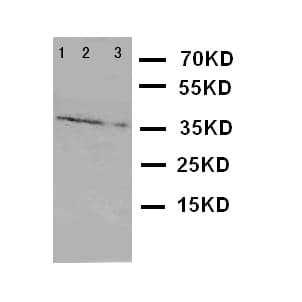
WB of GZMA / Granzyme A antibody. Lane 1: JURKAT Cell Lysate. Lane 2: CEM Cell Lysate. Lane 3: RAJI Cell Lysate.
GZMA / Granzyme A Antibody (aa175-190)
Primary AntibodyLSBio Guarantee
| Antibody: | Rabbit Polyclonal |
| Applications: | Immunohistochemistry (general), Immunohistochemistry, Paraffin, Western Blot |
| Reactivity: | Human |
| Format: | Lyophilized |
$480.00each
Catalog Number: LS-C312742-100
Catalog Number: LS-C312742
For bulk orders or custom formulations:
Request a QuoteOverview
- Description
- Granzyme A antibody LS-C312742 is an unconjugated rabbit polyclonal antibody to human Granzyme A (GZMA) (aa175-190). Validated for IHC and WB. Cited in 5 publications.
- Application
- IHC, IHC-P, WB
- Reactivity
- Hu
- Intended Use
- RUO
- Guarantees
- This antibody carries the LSBio 100% Guarantee. ✓
- Category
- Antibodies > Primary Antibodies > Polyclonal Antibodies
- Alternative Names
- CTLA3 | CTL tryptase | Granzyme-1 | H factor | HF | HFSP | Granzyme A | GZMA | Fragmentin-1 | Hanukah factor | Hanukkah factor
- UniProt Number
- P12544
- NCBI GenBank
- NM_006144, NP_006135.1
- SwissProt
- P12544
Target
- Target
- Human GZMA / Granzyme A
- Antigen Species
- Hu
- Gene Name
- GZMA
Antibody
- Host Species
- Rb
- Clonality
- Polyclonal
Immunogen
- Immunogen
- A synthetic peptide corresponding to a sequence in the middle region of human Granzyme A(175-190 aa DRKVCNDRNHYNFNPV).
- Immunogen Type
- SP-Lin
Format
- Conjugate/Label
- Unconj
- Format
- Lyophilized
- Formulation
- Lyophilized from 0.2mg Na2HPO4, 5mg BSA, 0.9mg NaCl, 0.05mg Thimerosal, 0.05mg sodium azide.
- Preservative
- Yes
- Purification Method
- AP
Storage & Handling
- Storage Conditions
- At -20°C for 1 year. After reconstitution, at 4°C for 1 month. It can also be aliquotted and stored frozen at -20°C for a longer time. Avoid freeze-thaw cycles.
- Recommended Storage Buffer
- NaCl
Lesional CD4+ IFN-?+ cytotoxic T lymphocytes in IgG4-related dacryoadenitis and sialoadenitis. Maehara T, Mattoo H, Ohta M, Mahajan VS, Moriyama M, Yamauchi M, Drijvers J, Nakamura S, Stone JH, Pillai SS. Annals of the rheumatic diseases. 2017 February;76:377-385. PubMed: 27358392 PMC: PMC5435236