
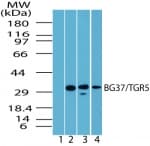
Western blot of BG37/TGR5 in spleen lysate. Lane 1 shows pre-immune sera. Lanes 2, 3 and 4 show antibody tested on human (1:1000), mouse (1:5000) and rat (1:5000) spleen lysate, respectively.
GPBAR1 / TGR5 Antibody
Primary AntibodyLSBio Guarantee
| Antibody: | Rabbit Polyclonal |
| Applications: | Immunohistochemistry (general), Western Blot |
| Reactivity: | Human, Mouse, Rat |
| Format: | Liquid |
$394.00each
Catalog Number: LS-C47388-100
Catalog Number: LS-C47388
For bulk orders or custom formulations:
Request a QuoteOverview
- Description
- TGR5 antibody LS-C47388 is an unconjugated rabbit polyclonal antibody to TGR5 (GPBAR1) from human. It is reactive with human, mouse and rat. Validated for WB. Cited in 1 publication.
- Application
- IHC, WB
- Reactivity
- Hu, Ms, Rt
- Intended Use
- RUO
- Guarantees
- This antibody carries the LSBio 100% Guarantee. ✓
- Category
- Antibodies > Primary Antibodies > Polyclonal Antibodies
- Alternative Names
- BG37 | GPR131 | HGPCR19 | M-BAR | GPBAR1 | GPCR19 | TGR5 | GPCR TGR5 | HBG37 | Membrane bile acid receptor
- Recommended Dilution: WB
- 1:1000 - 1:5000
- UniProt Number
- Q8TDU6
- NCBI GenBank
- AB083601, NP_733800.1
- SwissProt
- Q8TDU6
Target
- Target
- Human GPBAR1 / TGR5
- Antigen Species
- Hu
- Epitope
- A portion of amino acid 250-300 of human BG37/TGR5.
- Gene Name
- GPBAR1
Antibody
- Host Species
- Rb
- Clonality
- Polyclonal
Immunogen
- Immunogen
- A portion of amino acid250-300of human BG37/TGR5.
- Immunogen Type
- Pep
Format
- Conjugate/Label
- Unconj
- Format
- Liquid
- Formulation
- PBS with 0.02% Sodium Azide
- Concentration
- 1 mg/mL
- Volume
- 100 Microliter
- Preservative
- Yes
- Purification Method
- AP
Storage & Handling
- Storage Conditions
- Store at -20°C. Avoid freeze-thaw cycles.
- Recommended Storage Buffer
- PBS
Farnesoid X receptor induces Takeda G-protein receptor 5 cross-talk to regulate bile acid synthesis and hepatic metabolism. Pathak P, Liu H, Boehme S, Xie C, Krausz KW, Gonzalez F, Chiang JYL. The Journal of biological chemistry. 2017 June;292:11055-11069. PubMed: 28478385 PMC: PMC5491788