
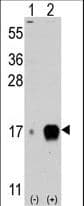
Western blot of IFITM3 (arrow) using rabbit polyclonal IFITM3 Antibody. 293 cell lysates (2 ug/lane) either nontransfected (Lane 1) or transiently transfected with the IFITM3 gene (Lane 2) (Origene Technologies).
Fragilis / IFITM3 Antibody (aa64-93)
Primary AntibodyLSBio Guarantee
| Antibody: | Rabbit Polyclonal |
| Applications: | Immunohistochemistry (general), Western Blot |
| Reactivity: | Human |
| Format: | Liquid |
$401.00each
Catalog Number: LS-C98677-400
Catalog Number: LS-C98677
For bulk orders or custom formulations:
Request a QuoteOverview
- Description
- IFITM3 antibody LS-C98677 is an unconjugated rabbit polyclonal antibody to human IFITM3 (Fragilis) (aa64-93). Validated for WB. Cited in 1 publication.
- Application
- IHC, WB
- Reactivity
- Hu
- Predicted Reactivity
- Ms
- Intended Use
- RUO
- Guarantees
- This antibody carries the LSBio 100% Guarantee. ✓
- Category
- Antibodies > Primary Antibodies > Polyclonal Antibodies
- Alternative Names
- 1-8U | Dispanin subfamily A member 2b | DSPA2b | Fragilis | IFITM3 | IP15
- Recommended Dilution: WB
- 1:1000
- UniProt Number
- Q01628
- NCBI GenBank
- NM_021034, NP_066362.2
- SwissProt
- Q01628
Target
- Target
- Human Fragilis / IFITM3
- Antigen Species
- Hu
- Epitope
- This Fagilis (IFITM3) antibody is generated from rabbits immunized with a KLH conjugated synthetic peptide between 64-93 amino acids from the Central region of human Fagilis (IFITM3).
- Gene Name
- IFITM3
Antibody
- Host Species
- Rb
- Clonality
- Polyclonal
- Origin Species
- Hu
Immunogen
- Immunogen Type
- SP-Lin
Format
- Conjugate/Label
- Unconj
- Format
- Liquid
- Formulation
- PBS, 0.09% Sodium Azide
- Volume
- 400 Microliter
- Preservative
- Yes
- Purification Method
- AS Ppt
Storage & Handling
- Storage Conditions
- Maintain refrigerated at 2°C to 8°C for up to 6 months. For long term storage store at -20°C.
- Recommended Storage Buffer
- PBS
IFITM3 inhibits influenza A virus infection by preventing cytosolic entry. Feeley EM, Sims JS, John SP, Chin CR, Pertel T, Chen LM, Gaiha GD, Ryan BJ, Donis RO, Elledge SJ, Brass AL. PLoS pathogens. 2011;7:e1002337. PubMed: 22046135 PMC: PMC3203188