
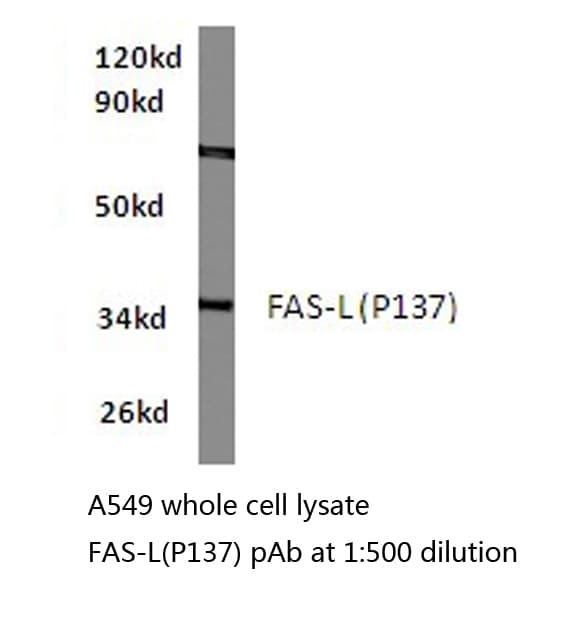
Western blot of FAS ligand/TNFL6 (P137) pAb in extracts from A549 cells.
FASLG / Fas Ligand Antibody (Pro137)
Primary AntibodyLSBio Guarantee
| Antibody: | Rabbit Polyclonal |
| Applications: | Immunofluorescence, Immunohistochemistry (general), Western Blot |
| Reactivity: | Human, Mouse |
| Format: | Liquid |
$328.00each
Catalog Number: LS-C176019-50
Catalog Number: LS-C176019
For bulk orders or custom formulations:
Request a QuoteOverview
- Description
- Fas Ligand antibody LS-C176019 is an unconjugated rabbit polyclonal antibody to Fas Ligand (FASLG) (Pro137) from human. It is reactive with human and mouse. Validated for IF, IHC and WB. Cited in 1 publication.
- Application
- IF, IHC, WB
- Reactivity
- Hu, Ms
- Intended Use
- Research Use Only
- Guarantees
- This antibody carries the LSBio 100% Guarantee. ✓
- Category
- Antibodies > Primary Antibodies > Polyclonal Antibodies
- Alternative Names
- ALPS1B | Apoptosis antigen ligand | APTL | CD95L | CD95 ligand | CD178 antigen | CD95-L | Fas antigen ligand | Fas ligand | FASL | TNFSF6 | APT1LG1 | CD178 | FASLG
- UniProt Number
- P48023
- NCBI GenBank
- NM_000639 | NP_000630.1
- SwissProt
- P48023
Target
- Target
- Human FASLG / Fas Ligand
- Antigen Species
- Human
- Epitope
- Human FASL / Fas Ligand
- Gene Name
- FASLG
Antibody
- Host Species
- Rabbit
- Clonality
- Polyclonal
Immunogen
- Immunogen
- Synthetic peptide around Pro137 of human FASL / Fas Ligand
- Immunogen Type
- Synthetic Peptide (Linear)
Format
- Conjugate/Label
- Unconjugated
- Format
- Liquid
- Formulation
- PBS, pH 7.2, 15 mM Sodium Azide
- Volume
- 50 Microliter
- Preservative
- Yes
- Purification Method
- Affinity Purified
Storage & Handling
- Storage Conditions
- Short term: store at 4°C. Long term: aliquot and store at -20°C. Avoid freeze-thaw cycles.
- Recommended Storage Buffer
- PBS
IL-1ß Promotes a New Function of DNase I as a Transcription Factor for the Fas Receptor Gene. Thiyagarajan D, Pedersen HL, Seredkina N, Horvei KD, Arranz L, Sonneveld R, Nijenhuis T, van der Vlag J, Rekvig OP. Frontiers in cell and developmental biology. 2018 February;6:7. PubMed: 29468159 PMC: PMC5807897