
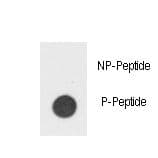
Dot blot of anti-hIL3R-pY766 Phospho-specific antibody on nitrocellulose membrane. 50ng of Phospho-peptide or Non Phospho-peptide per dot were adsorbed. Antibody working concentrations are 0.5ug per ml.
CSF2RB / CD131 Antibody (phospho-Tyr766)
Primary AntibodyLSBio Guarantee
| Antibody: | Rabbit Polyclonal |
| Applications: | Dot Blot, Immunohistochemistry (general), Western Blot |
| Reactivity: | Human |
| Format: | Liquid |
$401.00each
Catalog Number: LS-C96892-400
Catalog Number: LS-C96892
For bulk orders or custom formulations:
Request a QuoteOverview
- Description
- CD131 antibody LS-C96892 is an unconjugated rabbit polyclonal antibody to human CD131 (CSF2RB) (pTyr766). Validated for DB and WB. Cited in 1 publication.
- Application
- DB, IHC, WB
- Reactivity
- Hu
- Intended Use
- Research Use Only
- Guarantees
- This antibody carries the LSBio 100% Guarantee. ✓
- Category
- Antibodies > Primary Antibodies > Polyclonal Antibodies
- Alternative Names
- CD131 antigen | CDw131 | IL3RB | IL5RB | SMDP5 | CD131 | CSF2RB | GM-CSF receptor beta chain
- UniProt Number
- P32927
- NCBI GenBank
- NM_000395 | NP_000386.1
- SwissProt
- P32927
Recommended Dilution
| Application | Dilution |
|---|---|
| WB | 1:1000 |
Target
- Target
- Human CSF2RB / CD131
- Antigen Species
- Human
- Epitope
- This IL3R Antibody is generated from rabbits immunized with a KLH conjugated synthetic phosphopeptide corresponding to amino acid residues surrounding Y766 of human IL3R.
- Gene Name
- CSF2RB
Antibody
- Host Species
- Rabbit
- Clonality
- Polyclonal
- Origin Species
- Human
Immunogen
- Immunogen Type
- Synthetic Peptide (Linear)
Format
- Conjugate/Label
- Unconjugated
- Format
- Liquid
- Formulation
- PBS, 0.09% Sodium Azide
- Volume
- 400 Microliter
- Preservative
- Yes
- Purification Method
- Protein A Affinity
Storage & Handling
- Storage Conditions
- Maintain refrigerated at 2°C to 8°C for up to 6 months. For long term storage store at -20°C.
- Recommended Storage Buffer
- PBS
uPA and uPAR shRNA inhibit angiogenesis via enhanced secretion of SVEGFR1 independent of GM-CSF but dependent on TIMP-1 in endothelial and glioblastoma cells. Hari Raghu, Arun Kumar Nalla, Christopher S Gondi, Meena Gujrati, Dzunh H Dinh, Jasti S Rao. Molecular oncology. 2012 February;6:33-47. PubMed: 22177802 PMC: PMC3268919