
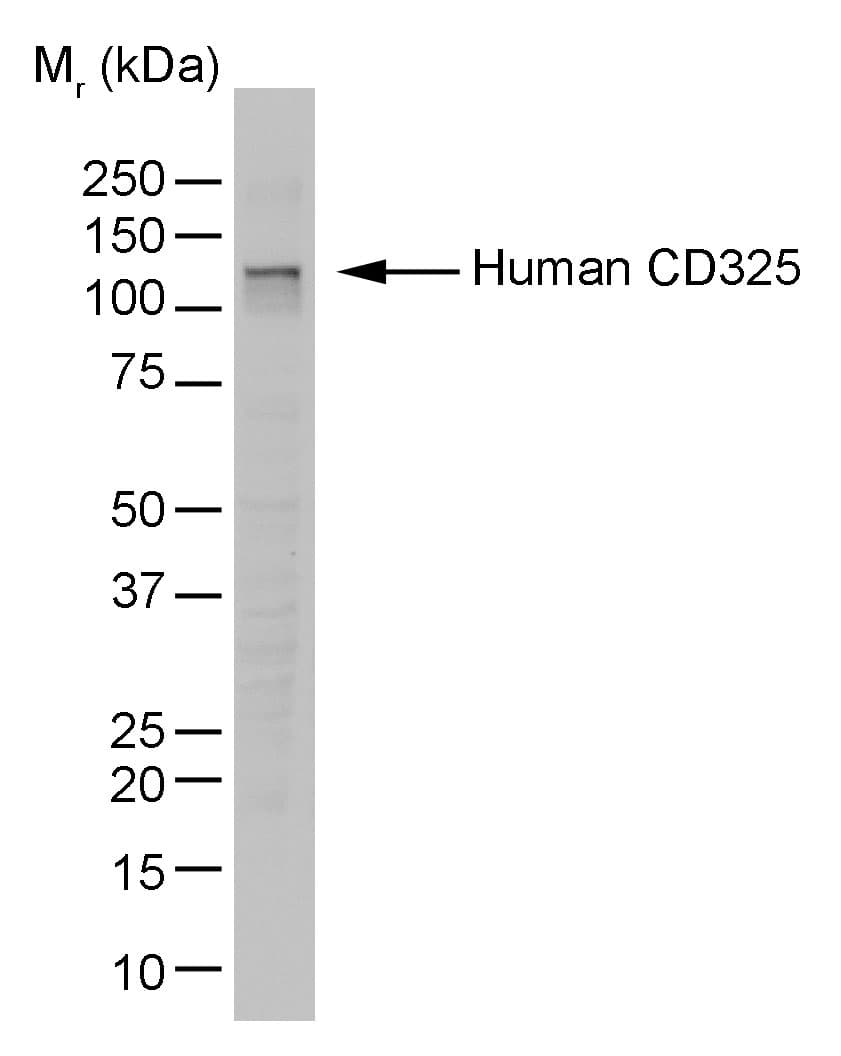
HT1080 lysate probed with Mouse anti-Human N-cadherin followed by Rabbit F(ab')2 anti-Mouse IgG:HRP
CDH2 / N Cadherin Antibody (Cytoplasmic Domain, clone 13A9)
Primary AntibodyLSBio Guarantee
| Antibody: | Mouse Monoclonal |
| Applications: | Immunofluorescence, Immunohistochemistry, Frozen, Immunohistochemistry, Paraffin, Immunoprecipitation, Western Blot |
| Reactivity: | Human |
| Format: | Liquid |
$415.00each
Catalog Number: LS-C187536-0.2
Catalog Number: LS-C187536
For bulk orders or custom formulations:
Request a QuoteOverview
- Description
- N Cadherin antibody LS-C187536 is an unconjugated mouse monoclonal antibody to human N Cadherin (CDH2) (Cytoplasmic Domain). Validated for IF, IHC, IP and WB.
- Application
- IF, IHC-F, IHC-P, IP, WB
- Reactivity
- Hu
- Intended Use
- Research Use Only
- Guarantees
- This antibody carries the LSBio 100% Guarantee. ✓
- Category
- Antibodies > Primary Antibodies > Monoclonal Antibodies
- Alternative Names
- CDH2 | CDw325 | CDHN | Cadherin-2 | CD325 | CD325 antigen | N Cadherin | N-cadherin | NCAD | Neural cadherin | N-cadherin 1 | Neural-cadherin
- Recommended Dilution: WB
- 1:100 - 1:1000
- UniProt Number
- P19022
- NCBI GenBank
- NM_001792 | NP_001783.2
- SwissProt
- P19022
Target
- Target
- Human CDH2 / N Cadherin
- Antigen Species
- Human
- Epitope
- Recognizes neural cadherin, otherwise known as CD325, a calcium dependent cell-cell adhesion glycoprotein, and member of the cadherin superfamily, which links to the actin cytoskeleton via catenins, and plays a role in cell-matrix adhesion, cell growth and differentiation, and the establishment of left-right asymmetry. N-cadherin is expressed by neurons, endothelial cells, muscle cells, and stem cells, and is one of the primary cadherins recruited to the site of neuronal synapse formation. N-cadherin is directly involved in the differentiation of early hematopoietic progenitors, and is commonly expressed by cancer cells, playing a role in transendothelial migration and metastasis, through the up-regulation of the src kinase pathway, and subsequent failure of the intercellular connection between two adjacent endothelial cells. Studies using clone 13A9 have demonstrated that expression levels of E-Cadherin and N-Cadherin have a role to play in the invasive properties of breast cancer. Decreased levels of E-cadherin and loss of E-cadherin-mediated adhesion, can result in the transition of a benign epithelial tumor to an invasive tumor, and increase invasiveness, whilst the expression of N-cadherin correlates with motility, invasiveness and tumor metastasis, irrespective of the presence of E-cadherin see for details. Clone 13A9 has been shown to be specific for N-cadherin, and does not recognize E-cadherin, M-cadherin or P-cadherin, see for details. Immunohistological studies have shown that clone 13A9 can be used as a reliable marker for the differential diagnosis of pleural mesotheliomas and lung adenocarcinomas, when used in conjunction with E-cadherin see for details.
- Gene Name
- CDH2
Antibody
- Host Species
- Mouse
- Clonality
- Monoclonal
- Clone
- 13A9
- Isotype
- IgG1
Immunogen
- Immunogen
- Recombinant MBP fusion protein containing the entire cytoplasmic domain of human N-cadherin.
- Immunogen Type
- Fusion Protein (e.g., GST, MBP tag)
Format
- Conjugate/Label
- Unconjugated
- Format
- Liquid
- Formulation
- PBS, 0.09% Sodium Azide
- Concentration
- 1 mg/mL
- Preservative
- Yes
- Purification Method
- Protein G Affinity
Storage & Handling
- Storage Conditions
- Store at 4°C or at -20°C. Store undiluted. Avoid freeze-thaw cycles. Microcentrifugation recommended if solution contains precipitate.
- Recommended Storage Buffer
- PBS