
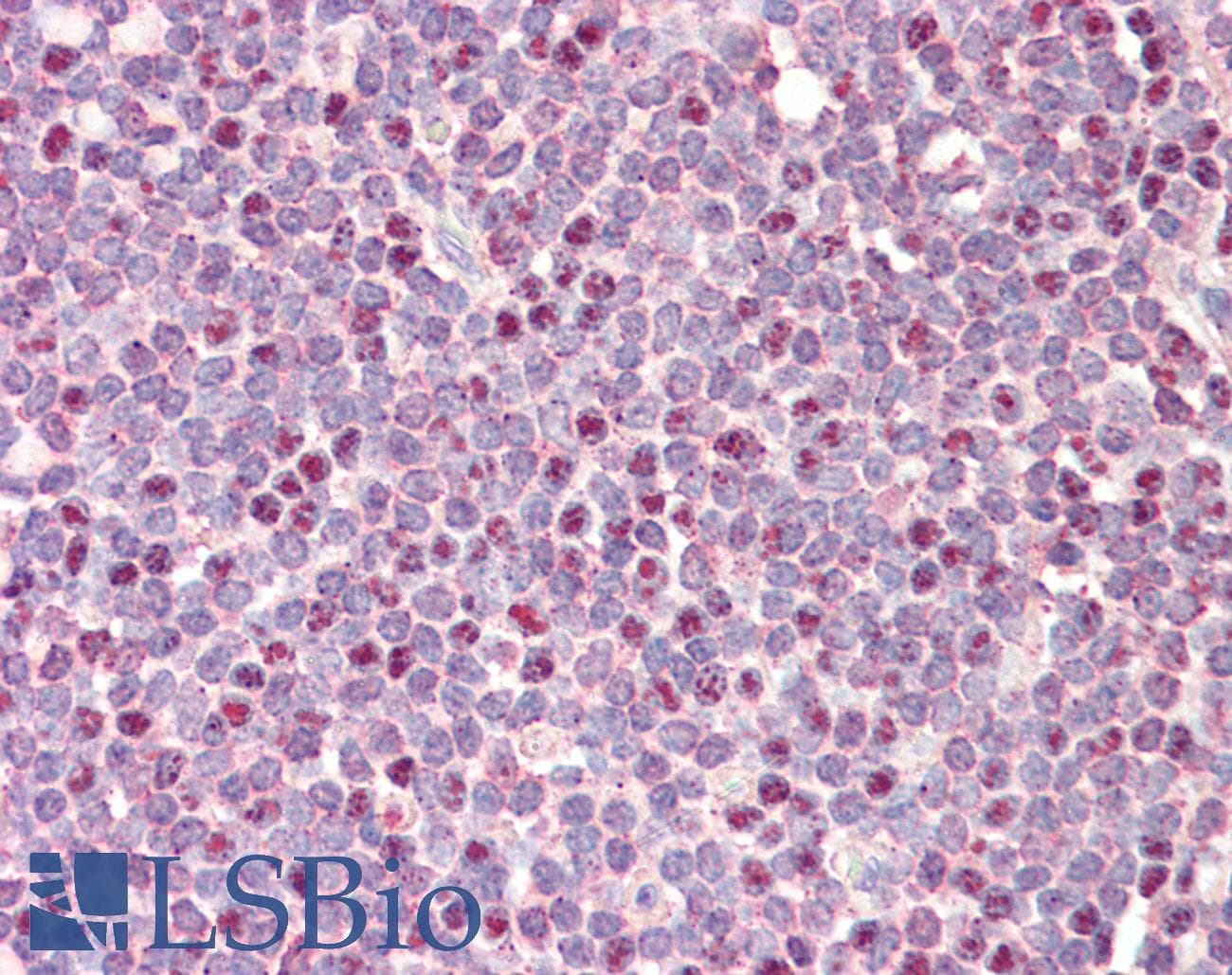
Anti-CDCA5 / Sororin antibody IHC staining of human tonsil. Immunohistochemistry of formalin-fixed, paraffin-embedded tissue after heat-induced antigen retrieval. Antibody concentration 10 ug/ml. This image was taken for the unconjugated form of this product. Other forms have not been tested.
CDCA5 / Sororin Antibody (aa110-159)
Primary AntibodyLSBio Guarantee
| Antibody: | Rabbit Polyclonal |
| Applications: | Immunohistochemistry (general), Immunohistochemistry, Paraffin, Western Blot |
| Reactivity: | Human |
| Format: | Liquid |
$383.00each
Catalog Number: LS-B9756-100
Catalog Number: LS-B9756
For bulk orders or custom formulations:
Request a QuoteOverview
- Description
- Sororin antibody LS-B9756 is an unconjugated rabbit polyclonal antibody to human Sororin (CDCA5) (aa110-159). Validated for IHC and WB. Cited in 1 publication.
- Application
- IHC, IHC-P, WB
- Reactivity
- Hu
- Intended Use
- RUO
- Guarantees
- This product carries the LSBio 100% Guarantee. ✓
- Category
- Antibodies > Primary Antibodies > Polyclonal Antibodies
- Alternative Names
- CDCA5 | p35 | Sororin
- Recommended Dilution: IHC-P
- 10 µg/ml
- Recommended Dilution: WB
- 0.2 - 1 µg/ml
- UniProt Number
- Q96FF9
- NCBI GenBank
- NM_080668, NP_542399.1
- SwissProt
- Q96FF9
Target
- Target
- CDCA5 / Sororin
- Antigen Species
- Hu
- Specificity
- Human CDCA5 / Sororin
- Epitope
- Human CDCA5 / Sororin
- Gene Name
- CDCA5
Antibody
- Host Species
- Rb
- Clonality
- Polyclonal
- Origin Species
- Hu
Immunogen
- Immunogen
- Synthetic peptide located between aa110-159 of human CDCA5 (Q96FF9, NP_542399). Percent identity by BLAST analysis: Human (100%); Gorilla, Gibbon (92%); Monkey (85%).
Format
- Conjugate/Label
- Unconj
- Format
- Liquid
- Formulation
- PBS, 0.09% sodium azide, 2% sucrose
- Volume
- 100 Microliter
- Animal Free
- No
- Carrier-Free
- Yes
- Preservative
- Yes
- Purification Method
- AP
Storage & Handling
- Storage Conditions
- Short term: Store at 2-8°C. Long term: Aliquot and store at -20°C. Avoid freeze/thaw cycles.
- Recommended Storage Buffer
- PBS
The Cohesin Complex Prevents the End Joining of Distant DNA Double-Strand Ends. Gelot C, Guirouilh-Barbat J, Le Guen T, Dardillac E, Chailleux C, Canitrot Y, Lopez BS. Molecular cell. 2016;61:15-26. PubMed: 26687679