
Western Blot (WB) analysis using CD71 Monoclonal Antibody against HEK293 (1) and MBP-hIgGFc transfected HEK293 (2) cell lysate.
CD71 / Transferrin Receptor Antibody
Primary AntibodyLSBio Guarantee
| Antibody: | Mouse Monoclonal |
| Applications: | Enzyme-Linked Immunosorbent Assay, Flow Cytometry, Immunofluorescence, Immunohistochemistry (general), Western Blot |
| Reactivity: | Human |
| Format: | Liquid |
$339.00each
Catalog Number: LS-C812535-50
Catalog Number: LS-C812535
For bulk orders or custom formulations:
Request a QuoteOverview
- Description
- Transferrin Receptor antibody LS-C812535 is an unconjugated mouse monoclonal antibody to human Transferrin Receptor (CD71). Validated for ELISA, Flow, IF, IHC and WB.
- Application
- ELISA, FC, IF, IHC, WB
- Reactivity
- Hu
- Intended Use
- RUO
- Guarantees
- This antibody carries the LSBio 100% Guarantee. ✓
- Category
- Antibodies > Primary Antibodies > Monoclonal Antibodies
- Alternative Names
- CD71 | TFR1 | TFRC | TRFR | TFR | TR | CD71 antigen | p90 | T9 | Transferrin receptor | Transferrin receptor protein 1
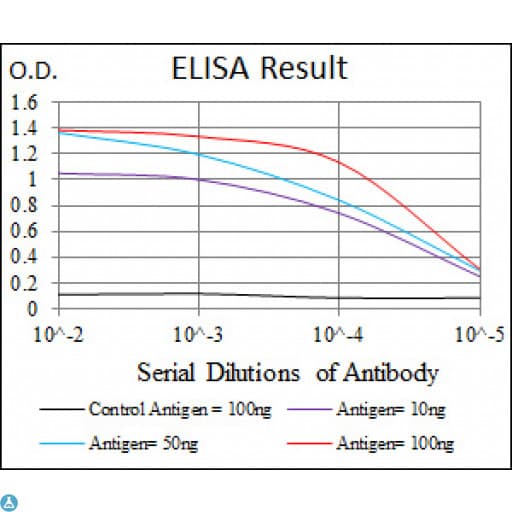
- Recommended Dilution: ELISA
- 1:10000
- Recommended Dilution: FC
- 1:200 - 1:400
- Recommended Dilution: IF/ICC
- 1:200 - 1:1000
- Recommended Dilution: IHC
- 1:200 - 1:1000
- Recommended Dilution: WB
- 1:500 - 1:2000
- UniProt Number
- P02786
- NCBI GenBank
- NM_003234, NP_003225.2
- SwissProt
- P02786
Target
- Target
- Human CD71 / Transferrin Receptor
- Antigen Species
- Hu
- Epitope
- CD71 monoclonal antibody detects endogenous levels of CD71 protein.
- Gene Name
- TFRC
Antibody
- Host Species
- Ms
- Clonality
- Monoclonal
- Isotype
- IgG1
- Origin Species
- Hu
Immunogen
- Immunogen
- Purified recombinant fragment of human CD71 expressed in E. Coli.
- Immunogen Type
- Frag-RP
Format
- Conjugate/Label
- Unconj
- Format
- Liquid
- Formulation
- Purified ascitic fluid, 0.03% sodium azide
- Preservative
- Yes
- Purification Method
- AP
Storage & Handling
- Storage Conditions
- Store at -20°C. Avoid freeze-thaw cycles.