
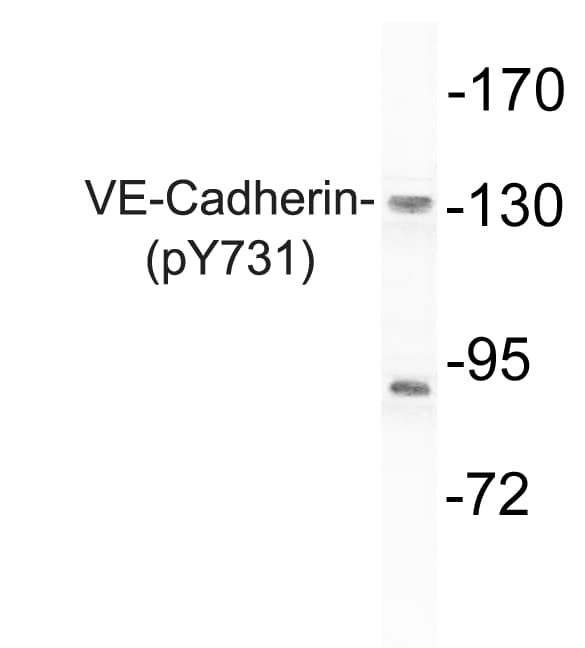
Western blot of p-VE-Cadherin (Y731) pAb in extracts from HepG2 cells treated with Na3VO4.
CD144 / CDH5 / VE Cadherin Antibody (phospho-Tyr731)
Primary AntibodyLSBio Guarantee
| Antibody: | Rabbit Polyclonal |
| Applications: | Immunohistochemistry (general), Immunohistochemistry, Paraffin, Western Blot |
| Reactivity: | Human, Mouse |
| Format: | Liquid |
$335.00each
Catalog Number: LS-C177974-50
Catalog Number: LS-C177974
For bulk orders or custom formulations:
Request a QuoteOverview
- Description
- VE Cadherin antibody LS-C177974 is an unconjugated rabbit polyclonal antibody to VE Cadherin (CD144 / CDH5) (pTyr731) from human. It is reactive with human and mouse. Validated for IHC and WB. Cited in 1 publication.
- Application
- IHC, IHC-P, WB
- Reactivity
- Hu, Ms
- Intended Use
- Research Use Only
- Guarantees
- This antibody carries the LSBio 100% Guarantee. ✓
- Category
- Antibodies > Primary Antibodies > Polyclonal Antibodies
- Alternative Names
- 7B4 | 7B4 antigen | CD144 | CDH5 | Cadherin-5 | Endothelial-specific cadherin | Vascular endothelial cadherin | VE-cadherin | VEC | CD144 antigen | VE Cadherin
- UniProt Number
- P33151
- NCBI GenBank
- NM_001795 | NP_001786.2
- SwissProt
- P33151
Target
- Target
- Human CD144 / CDH5 / VE Cadherin
- Antigen Species
- Human
- Epitope
- Human CD144 / VE Cadherin
- Gene Name
- CDH5
Antibody
- Host Species
- Rabbit
- Clonality
- Polyclonal
Immunogen
- Immunogen
- Synthetic phosphopeptide around pTyr731 of human CD144 / VE Cadherin
- Immunogen Type
- Synthetic Peptide (Linear)
Format
- Conjugate/Label
- Unconjugated
- Format
- Liquid
- Formulation
- PBS, pH 7.2, 0.05% Sodium Azide
- Volume
- 50 Microliter
- Preservative
- Yes
- Purification Method
- Affinity Purified
Storage & Handling
- Storage Conditions
- Short term: store at 4°C. Long term: aliquot and store at -20°C. Avoid freeze-thaw cycles.
- Recommended Storage Buffer
- PBS
New continuous-flow total artificial heart and vascular permeability. Feng J, Cohn WE, Parnis SM, Sodha NR, Clements RT, Sellke N, Frazier OH, Sellke FW. The Journal of surgical research. 2015;199:296-305. PubMed: 26188957 PMC: PMC4636951