
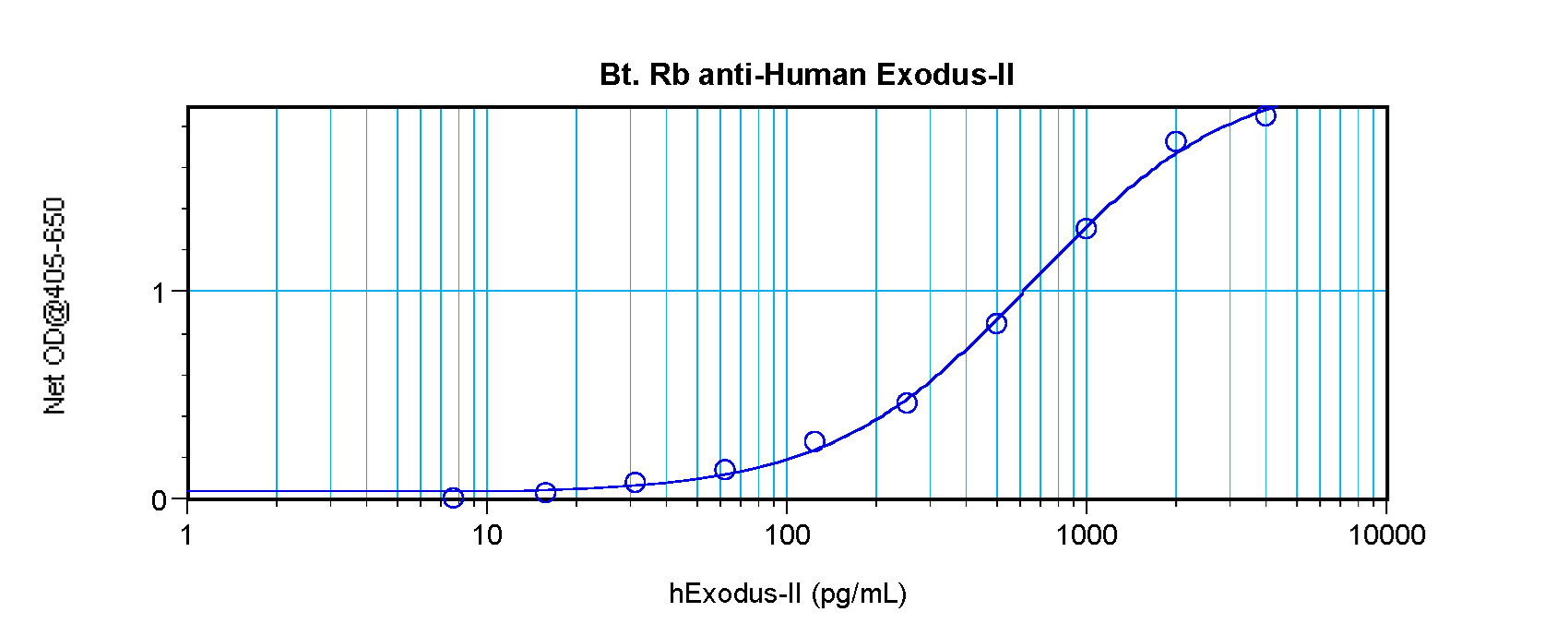
Biotinylated Anti-Human Exodus-2 (CCL21) Sandwich ELISA
CCL21 / SLC Antibody (Biotin)
Primary AntibodyLSBio Guarantee
| Antibody: | Rabbit Polyclonal |
| Applications: | Enzyme-Linked Immunosorbent Assay, Western Blot |
| Reactivity: | Human |
| Format: | Lyophilized |
$364.00each
Catalog Number: LS-C104622-25
Catalog Number: LS-C104622
For bulk orders or custom formulations:
Request a QuoteOverview
- Description
- SLC antibody LS-C104622 is a biotin-conjugated rabbit polyclonal antibody to human SLC (CCL21). Validated for ELISA and WB. Cited in 1 publication.
- Application
- ELISA, WB
- Reactivity
- Hu
- Intended Use
- RUO
- Guarantees
- This antibody carries the LSBio 100% Guarantee. ✓
- Category
- Antibodies > Primary Antibodies > Polyclonal Antibodies
- Alternative Names
- 6Ckine | Beta chemokine exodus-2 | C-C motif chemokine 21 | CCL21 | Beta-chemokine exodus-2 | CKb9 | ECL | Small-inducible cytokine A21 | SCYA21 | SLC | Exodus-2 | TCA4
- UniProt Number
- O00585
- NCBI GenBank
- NM_002989, NP_002980.1
- SwissProt
- O00585
Target
- Target
- Human CCL21 / SLC
- Antigen Species
- Hu
- Epitope
- Human Exodus-2
- Gene Name
- CCL21
Antibody
- Host Species
- Rb
- Clonality
- Polyclonal
Immunogen
- Immunogen
- E.coli derived recombinant Human Exodus-2.
- Immunogen Type
- Recom
Format
- Conjugate/Label
- Biotin
- Format
- Lyophilized
- Formulation
- Lyophilized from PBS, pH 7.2
- Preservative
- No
- Purification Method
- AP
Storage & Handling
- Storage Conditions
- Store Lyophilized at room temperature up to 1 month; Reconstituted for up to 2 weeks at 2°C to 8°C. Aliquot and freeze at -20°C for long term storage. Avoid freeze/thaw cycles.
- Recommended Storage Buffer
- PBS
Integrated pharmacokinetic, pharmacodynamic and immunogenicity profiling of an anti-CCL21 monoclonal antibody in cynomolgus monkeys. Dudal S, Subramanian K, Flandre T, Law WS, Lowe PJ, Skerjanec A, Genin JC, Duval M, Piequet A, Cordier A, Jarai G, Van Heeke G, Taplin S, Krantz C, Jones S, Warren AP, Brennan FR, Sims J, Lloyd P. mAbs. 2015;7:829-37. PubMed: 26230385 PMC: PMC4622749