
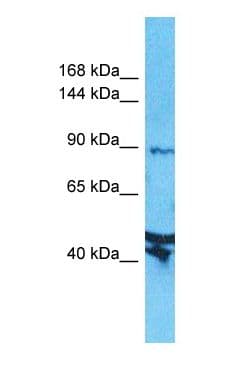
Western blot of AXIN2 Antibody with human Jurkat Whole Cell lysate. This image was taken for the unconjugated form of this product. Other forms have not been tested.
AXIN2 / Axin 2 Antibody (N-Terminus)
Primary AntibodyLSBio Guarantee
| Antibody: | Rabbit Polyclonal |
| Applications: | Western Blot |
| Reactivity: | Human |
| Format: | Liquid |
$433.00each
Catalog Number: LS-C345085-100
Catalog Number: LS-C345085
For bulk orders or custom formulations:
Request a QuoteOverview
- Description
- Axin 2 antibody LS-C345085 is an unconjugated rabbit polyclonal antibody to human Axin 2 (AXIN2) (N-Terminus). Validated for WB. Cited in 1 publication.
- Application
- WB
- Reactivity
- Hu
- Intended Use
- RUO
- Guarantees
- This antibody carries the LSBio 100% Guarantee. ✓
- Category
- Antibodies > Primary Antibodies > Polyclonal Antibodies
- Alternative Names
- AXIN2 | AXIL | Axin-2 | Axis inhibition protein 2 | Axin 2 | Axin-like protein | Conductin
- UniProt Number
- Q9Y2T1
- NCBI GenBank
- NM_004655, NP_004646.3
- SwissProt
- Q9Y2T1
Target
- Target
- Human AXIN2 / Axin 2
- Antigen Species
- Hu
- Epitope
- Human AXIN2 / Axin 2
- Gene Name
- AXIN2
Antibody
- Host Species
- Rb
- Clonality
- Polyclonal
Immunogen
- Immunogen
- The immunogen for Anti-AXIN2 antibody is: synthetic peptide directed towards the N-Terminus of Human AXIN2. Percent identity by BLAST analysis: Dog, Pig, Rat, Human, Mouse, Rabbit, Guinea pig (100%); Bovine, Zebrafish (93%).
- Immunogen Type
- SP-Lin
Format
- Conjugate/Label
- Unconj
- Format
- Liquid
- Formulation
- PBS, 0.09% sodium azide, 2% sucrose
- Concentration
- 0.5 mg/mL
- Volume
- 100 Microliter
- Preservative
- Yes
- Purification Method
- AP
Storage & Handling
- Storage Conditions
- Short term: Store at 2-8°C. Long term: Aliquot and store at -20°C. Avoid freeze/thaw cycles.
- Recommended Storage Buffer
- PBS
Maternal Huluwa dictates the embryonic body axis through ß-catenin in vertebrates. Yan L, Chen J, Zhu X, Sun J, Wu X, Shen W, Zhang W, Tao Q, Meng A. Science (New York, N.Y.). 2018 November;362. PubMed: 30467143