
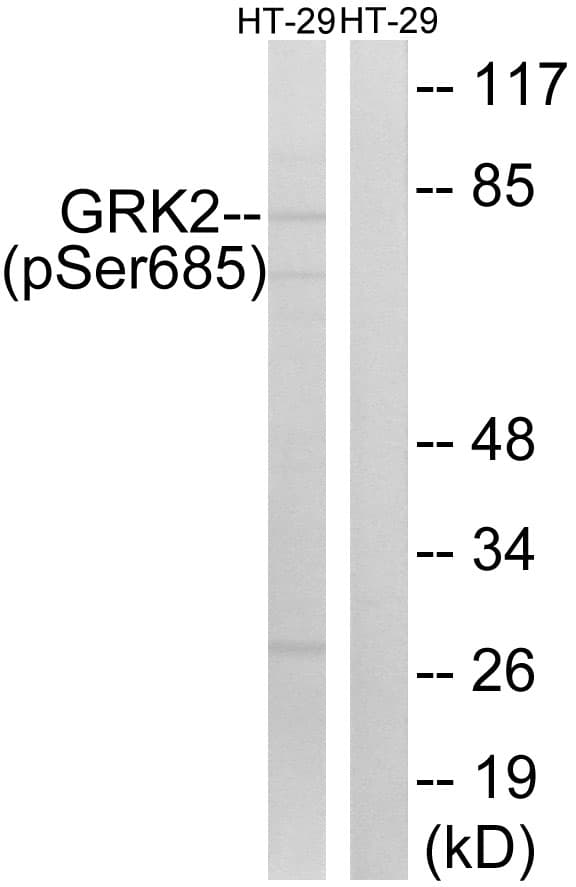
Western blot analysis of lysates from HT29 cells treated with insulin 0.01U/ml 15', using GRK2 (Phospho-Ser685) Antibody. The lane on the right is blocked with the phospho peptide.
ADRBK1 / GRK2 Antibody (phospho-Ser685)
Primary AntibodyLSBio Guarantee
| Antibody: | Rabbit Polyclonal |
| Applications: | Enzyme-Linked Immunosorbent Assay, Western Blot |
| Reactivity: | Human, Mouse, Rat |
| Format: | Liquid |
$341.00each
Catalog Number: LS-C199027-50
Catalog Number: LS-C199027
For bulk orders or custom formulations:
Request a QuoteOverview
- Description
- GRK2 antibody LS-C199027 is an unconjugated rabbit polyclonal antibody to GRK2 (ADRBK1) (pSer685) from human. It is reactive with human, mouse and rat. Validated for Peptide-ELISA and WB. Cited in 1 publication.
- Application
- ELISA, WB
- Reactivity
- Hu, Ms, Rt
- Intended Use
- Research Use Only
- Guarantees
- This antibody carries the LSBio 100% Guarantee. ✓
- Category
- Antibodies > Primary Antibodies > Polyclonal Antibodies
- Alternative Names
- ADRBK1 | BARK1 | Beta-ARK-1 | BETA-ARK1 | BARK | Betaark1 | GRK2
- UniProt Number
- P25098
- NCBI GenBank
- NM_001619 | NP_001610.2
- SwissProt
- P25098
Recommended Dilution
| Application | Dilution |
|---|---|
| WB | 1:500 - 1:1000 |
Target
- Target
- Human ADRBK1 / GRK2
- Antigen Species
- Human
- Epitope
- GRK2 (Phospho-Ser685) Antibody detects endogenous levels of GRK2 only when phosphorylated at serine685.
- Gene Name
- GRK2
Antibody
- Host Species
- Rabbit
- Clonality
- Polyclonal
- Isotype
- IgG
Immunogen
- Immunogen
- Synthetic peptide derived from human GRK2 around the phosphorylation site of Ser685. (AA Range: 640-689)
- Immunogen Type
- Synthetic Peptide (Linear)
Format
- Conjugate/Label
- Unconjugated
- Format
- Liquid
- Formulation
- PBS, pH 7.4, 150 mM NaCl, 0.02% Sodium Azide, 50% Glycerol
- Concentration
- 1 mg/mL
- Volume
- 50 Microliter
- Preservative
- Yes
- Purification Method
- Affinity Purified
Storage & Handling
- Storage Conditions
- Store at -20°C.
- Recommended Storage Buffer
- PBS|150 mM NaCl
Myocardial function after polarizing versus depolarizing cardiac arrest with blood cardioplegia in a porcine model of cardiopulmonary bypass. Aass T, Stangeland L, Moen CA, Salminen PR, Dahle GO, Chambers DJ, Markou T, Eliassen F, Urban M, Haaverstad R, Matre K, Grong K. European journal of cardio-thoracic surgery : official journal of the European Association for Cardio-thoracic Surgery. 2016;50:130-9. PubMed: 26843432 PMC: PMC4913873