
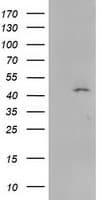
HEK293T cells were transfected with the pCMV6-ENTRY control (Left lane) or pCMV6-ENTRY SERPINB4 (Right lane) cDNA for 48 hrs and lysed. Equivalent amounts of cell lysates (5 ug per lane) were separated by SDS-PAGE and immunoblotted with anti-SERPINB4.
SERPINB4 / SCCA1+2 Antibody (clone OTI4C8)
Primary AntibodyLSBio Guarantee
| Antibody: | Mouse Monoclonal |
| Applications: | Immunohistochemistry (general), Immunohistochemistry, Paraffin, Western Blot |
| Reactivity: | Human |
| Format: | Liquid |
$443.00each
Catalog Number: LS-C172653-100
Catalog Number: LS-C172653
For bulk orders or custom formulations:
Request a QuoteOverview
- Description
- SCCA1+2 antibody LS-C172653 is an unconjugated mouse monoclonal antibody to human SCCA1+2 (SERPINB4). Validated for IHC and WB. Cited in 2 publications.
- Application
- IHC, IHC-P, WB
- Reactivity
- Hu
- Intended Use
- RUO
- Guarantees
- This antibody carries the LSBio 100% Guarantee. ✓
- Category
- Antibodies > Primary Antibodies > Monoclonal Antibodies
- Alternative Names
- PI-11 | LEUPIN | SCCA2/SCCA1 fusion protein | Serpin B4 | PI11 | SCCA-2 | SCCA1 | Peptidase inhibitor 11 | SCCA2 | SERPINB4
- Recommended Dilution: IHC-P
- 1:150
- Recommended Dilution: WB
- 1:500
- UniProt Number
- P48594
- SwissProt
- P48594
Target
- Target
- Human SERPINB4 / SCCA1+2
- Antigen Species
- Hu
- Epitope
- Human SERPINB4 / SCCA2
- Gene Name
- SERPINB4
Antibody
- Host Species
- Ms
- Clonality
- Monoclonal
- Clone
- OTI4C8
- Isotype
- IgG1
Immunogen
- Immunogen
- Full length human recombinant protein of human SERPINB4 (NP_002965) produced in HEK293T cell.
- Immunogen Type
- FL-RP
Format
- Conjugate/Label
- Unconj
- Format
- Liquid
- Formulation
- PBS, pH 7.3, 0.02% Sodium Azide, 50% Glycerol, 1% BSA
- Volume
- 100 Microliter
- Preservative
- Yes
- Purification Method
- Prot A/G
Storage & Handling
- Storage Conditions
- Store at -20°C. Avoid freeze-thaw cycles.
- Recommended Storage Buffer
- PBS
Proteogenomic analysis of psoriasis reveals discordant and concordant changes in mRNA and protein abundance. Swindell WR, Remmer HA, Sarkar MK, Xing X, Barnes DH, Wolterink L, Voorhees JJ, Nair RP, Johnston A, Elder JT, Gudjonsson JE. Genome medicine. 2015;7:86. PubMed: 26251673 PMC: PMC4527112