
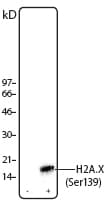
Untreated (Lane 1) and staurosporine-treated (Lane 2) Jurkat nuclear extract was resolved by electrophoresis, transferred to nitrocellulose and probed with anti-phospho-H2A. X (Ser 139) antibody. Proteins were visualized using a goat anti-mouse secondary a.
H2AFX / H2AX Antibody (phospho-Ser139, clone 2F3)
Primary AntibodyLSBio Guarantee
| Antibody: | Mouse Monoclonal |
| Applications: | Immunocytochemistry, Immunofluorescence, Immunohistochemistry (general), Western Blot |
| Reactivity: | Human |
| Format: | Liquid |
$293.00each
Catalog Number: LS-C41114-25
Catalog Number: LS-C41114
For bulk orders or custom formulations:
Request a QuoteOverview
- Description
- H2AX antibody LS-C41114 is an unconjugated mouse monoclonal antibody to human H2AX (H2AFX) (pSer139). Validated for ICC, IF and WB. Cited in 5 publications.
- Application
- ICC, IF, IHC, WB
- Reactivity
- Hu
- Intended Use
- RUO
- Guarantees
- This antibody carries the LSBio 100% Guarantee. ✓
- Category
- Antibodies > Primary Antibodies > Monoclonal Antibodies
- Alternative Names
- H2AFX | H2AX | Histone H2A.x | H2A.X | H2A histone family, member X | H2AX histone
- UniProt Number
- P16104
- NCBI GenBank
- NM_002105, NP_002096.1
- SwissProt
- P16104
Target
- Target
- Human H2AFX / H2AX
- Antigen Species
- Hu
- Epitope
- Modified peptide (KATQAS*QEY)
- Gene Name
- H2AX
Antibody
- Host Species
- Ms
- Clonality
- Monoclonal
- Clone
- 2F3
- Isotype
- IgG2b
Immunogen
- Immunogen
- Synthetic peptide from human H2AFX / H2AX.
- Immunogen Type
- SP-Lin
Format
- Conjugate/Label
- Unconj
- Format
- Liquid
- Formulation
- Phosphate-buffered solution, pH 7.2, 0.09% sodium azide.
- Concentration
- 0.5 mg/mL
- Preservative
- Yes
- Purification Method
- AP
Storage & Handling
- Storage Conditions
- Store at 4°C. Store undiluted.
- Recommended Storage Buffer
- Phosphate-buffered
Splicing regulator SC35 is essential for genomic stability and cell proliferation during mammalian organogenesis. Xiao R, Sun Y, Ding JH, Lin S, Rose DW, Rosenfeld MG, Fu XD, Li X. Molecular and cellular biology. 2007;27:5393-402. PubMed: 17526736 PMC: PMC1952092